To advertise on ChatGPT, you apply for OpenAI’s self-serve Ads Manager at ads.openai.com, add a payment method, and build a campaign with a daily budget, a bidding goal (clicks or conversions), “context hints” that describe the conversations your ad fits, and a sponsored ad that links to your site. Ads appear as a labeled “Sponsored” card below ChatGPT’s answer, and you pay through an auction. Below is the full setup, what it costs, how targeting really works, and what happened when we ran our own first campaign in November 2026.
Key Takeaways
- ChatGPT ads are bought in OpenAI’s Ads Manager (beta) or through OpenAI’s agency partners. Access has been opening gradually since May 2026.
- Ads show below the answer, are labeled as sponsored, and OpenAI says they do not change what ChatGPT answers.
- Targeting is based on conversation context, not exact keywords. That makes it easy to show up in conversations you never intended.
- Pricing is an auction. Since November 9, 2026, new campaigns use Target CPC or Target CPA goals.
- Set up conversion tracking before you spend a dollar. Without it you cannot tell clicks from customers.
What ChatGPT Ads Are
A ChatGPT ad is a sponsored unit that appears under a ChatGPT response when the conversation matches what an advertiser offers. It shows the advertiser’s name, a headline, a short description and a link to a landing page, and it is clearly marked as an ad. OpenAI’s announcement of new ways to buy ChatGPT ads (May 5, 2026) states that answers stay independent of ads and that advertisers do not receive users’ conversations or personal details. Advertisers only see aggregated performance data.
According to OpenAI’s help center article Ads in ChatGPT: the basics, ads are shown to users on the Free and Go plans. Paid plans such as Plus, Pro, Business and Enterprise do not see ads. That matters for planning: your audience is the large group of everyday ChatGPT users, not necessarily the heaviest professional users.
Who Can Advertise on ChatGPT
There are two ways in. Large brands often buy through OpenAI’s agency partners. Everyone else can apply for the self-serve Ads Manager, which OpenAI describes as built for businesses of every size, from startups to global brands. You request access at ads.openai.com, and approval has been rolling out in stages, so apply before you need it.
Once approved, Ads Manager lets you register your business, add payment details, set budgets and bids, upload ads, launch campaigns and see results, all in one place. An agency can manage the account for you, but OpenAI’s system makes every delivery decision.
How to Advertise on ChatGPT: Step by Step
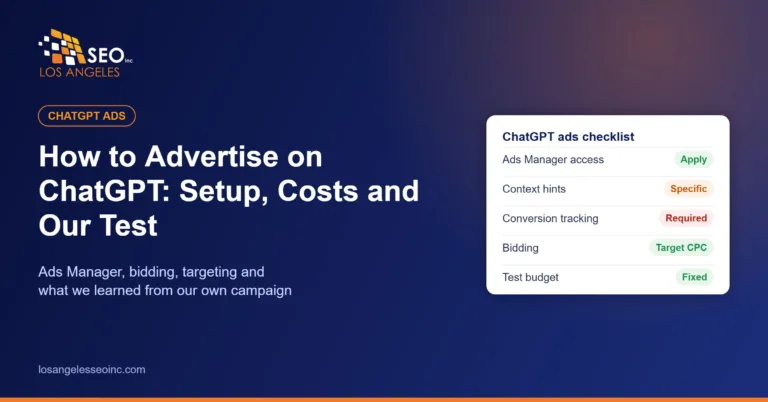
- Apply for Ads Manager access with your business details and website.
- Add a payment method and confirm your billing country.
- Choose the campaign goal. Click campaigns optimize for visits. Conversion campaigns optimize for leads, sign-ups or purchases, but they need working conversion tracking first.
- Set a daily budget you are comfortable losing while you learn. Treat the first month as a test.
- Create an ad group with context hints. Describe the conversations, problems and topics where your offer genuinely helps, in plain language.
- Write the ad. A clear headline, one specific benefit and a landing page that matches the promise. Add UTM tags to the URL so the visits are labeled in Google Analytics.
- Install measurement. OpenAI offers a pixel and a Conversions API. Use one of them, then test a form submission before launch.
- Launch, then review placements and results weekly. Adjust context hints, copy and bids based on leads, not clicks.
How Targeting Works (and Why It Surprises People)
Google Ads matches ads to search keywords. ChatGPT ads work differently. OpenAI’s ChatGPT Ads FAQ explains that its system picks ads based on expected relevance: the context of the conversation, your ad copy and landing page, the context hints you add, and, for users who allow personalization, signals from their wider ChatGPT use. OpenAI is direct about the limits: context hints “are not exact-match keywords and do not guarantee delivery in specific conversations.”
In practice, broad hints produce broad placements. If your hints say “California businesses” or “marketing help,” your ad can appear in conversations that are only loosely related. The only exclusion control is Negative Phrases, and OpenAI makes it available to qualifying advertisers for brand-safety needs, not as a general keyword filter. So the best protection is specific hints and a landing page that makes your offer unmistakable.
How Much It Costs to Advertise on ChatGPT
ChatGPT ads are sold in an auction, and you set the daily budget. The pilot started with cost-per-thousand-impression (CPM) buying, and cost-per-click (CPC) bidding was added in May 2026. According to OpenAI’s help article on bidding strategies and pricing, since November 9, 2026 new campaigns choose between:
- Intelligent bidding, which adjusts bids toward your goal within your budget without a target.
- Target CPC for click campaigns, an average cost-per-click goal.
- Target CPA for conversion campaigns, an average cost-per-conversion goal.
The older Max Bid and Max CPC controls retire for existing campaigns on January 1, 2027. A target is an average, not a guaranteed price, and OpenAI warns that a target far below your recent results can limit delivery. Its FAQ suggests starting click bids around $3 to $5. OpenAI also says there are no official performance benchmarks yet, so treat any “average ChatGPT CPC” you read online as an estimate.
What Happened When We Tested ChatGPT Ads
We believe in testing a channel on our own money before recommending it to clients. On November 12, 2026 we launched a small click campaign called “AI Visibility Check – California,” promoting our free AI visibility check with a $25 daily budget. By November 20 it had:
- 1,922 impressions reaching 1,427 people
- 15 clicks, a 0.78% click-through rate
- $31.84 in total spend, well under the budget we allowed
- No calls or qualified leads
Three lessons came out of it. First, one of our clients saw our ad while asking ChatGPT about electric bikes, which shows how loosely context matching can behave with broad hints. Second, an “AI visibility” offer attracted other marketers more than business owners, because marketers are the people asking ChatGPT about AI visibility. Third, we launched before conversion tracking was verified, so Ads Manager could not tell us which clicks mattered. Our fix list: specific, buyer-language context hints, a landing page written for owners rather than marketers, verified conversion tracking, and a decision point after a defined test period.
Is Advertising on ChatGPT Right for Your Business?
ChatGPT ads make the most sense when people already ask ChatGPT to compare options in your category: “best accounting software for a small law firm,” “which CRM for a home services company,” “how to choose a dentist for implants.” Businesses with clear offers, strong landing pages and working tracking learn fastest. If your leads mostly come from people searching for a provider near them, Google Ads and local SEO are still the more predictable first investment, and ChatGPT ads can be a small test alongside them.
Paid placement is also only half of AI visibility. Being mentioned in the answer itself comes from ChatGPT SEO: clear service pages, consistent business information and trusted third-party mentions.
Checklist Before You Launch
- Conversion tracking installed and tested with a real form submission
- UTM tags on every ad URL
- Context hints written in the words your buyers use, not industry jargon
- A landing page that names who the offer is for in the first sentence
- A fixed test budget and a date to decide whether to continue
- A weekly check of where clicks come from and which turn into leads
Frequently Asked Questions
How do I advertise on ChatGPT?
Apply for OpenAI’s Ads Manager at ads.openai.com, add payment details, then create a campaign with a budget, a bidding goal, context hints and an ad that links to your website. Large advertisers can also buy through OpenAI’s agency partners.
How much do ChatGPT ads cost?
There is no fixed price. Ads are sold in an auction, you control the daily budget, and new campaigns use Target CPC or Target CPA goals. OpenAI suggests starting click bids around $3 to $5.
Who sees ads in ChatGPT?
Users on the Free and Go plans. OpenAI says Plus, Pro, Business and Enterprise users do not see ads.
Can I choose exact keywords for ChatGPT ads?
No. You describe relevant conversations with context hints, but OpenAI says they are not exact-match keywords and do not guarantee placement.
Do ads change ChatGPT’s answers?
OpenAI states that answers stay independent of ads and that advertisers do not receive users’ conversations or personal details.
Want help testing ChatGPT ads without wasting budget? See our ChatGPT Ads management service, or start with a free AI visibility check to see how AI assistants describe your business today.