
When someone asks ChatGPT, Gemini, Perplexity, or another AI search tool to recommend a business, the answer may contain only a few names. Understanding why certain businesses appear—and others do not—is becoming an important part of modern search visibility.
But there is an important distinction between AI search visibility and traditional search rankings.
Google has established ranking systems and documented Search features. AI products can combine language models, search retrieval, business information, and other sources in different ways. Their exact selection and ranking systems are proprietary and can change over time.
That means there is no single “GEO ranking factor” or secret formula that guarantees a business will be mentioned.
What businesses can do is make their information easy to discover, understand, verify, and reference when relevant questions are asked.
This guide explains how major AI search experiences find information about businesses, what signals appear to matter across platforms, what businesses can control, and how to build a stronger foundation for AI search visibility without abandoning traditional SEO.
Answer-first summary
AI search systems can mention businesses when they have sufficient, relevant information to identify the business and connect it to the user’s question. That information can come from a company’s website, search results, business listings, third-party publications, reviews, directories, and other publicly available sources.
ChatGPT, Gemini, and Perplexity do not necessarily use the same retrieval or citation process. Some answers may rely on information already available to the model, while search-enabled experiences can retrieve current web information and provide sources.
The practical takeaway is straightforward: build a business presence that is easy for search systems to discover and easy to understand.
That means maintaining accurate business information, creating useful and original content, strengthening relevant third-party mentions, maintaining a strong local and organic SEO foundation, and monitoring how your brand appears across AI search experiences.
Key takeaways
- AI visibility is not the same as a traditional ranking. A business can be mentioned, cited, recommended, or omitted depending on the question and the information available to the AI system.
- Different AI platforms use different systems. ChatGPT, Gemini, Perplexity, and Google’s AI Search experiences can retrieve and present information differently.
- There is no universal AI ranking formula. Much of how individual systems select and synthesize information is proprietary.
- Clear business information matters. Your website should make it obvious who you are, what you offer, where you operate, and who you serve.
- Third-party information provides additional context. Relevant publications, directories, reviews, industry websites, and other independent sources can help establish a broader picture of a business.
- Traditional SEO remains foundational. Search visibility, crawlability, useful content, technical health, and authority continue to matter in an AI-driven search environment.
What does it mean for a business to appear in AI search?
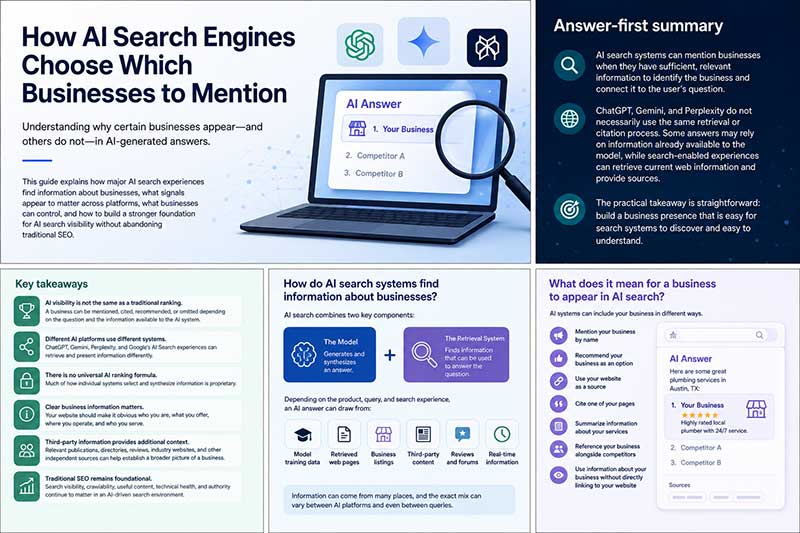
AI search visibility is the ability of a business, brand, product, or website to appear in responses generated by AI-powered search experiences.
There are several ways this can happen.
An AI system might:
- Mention your business by name.
- Recommend your business as an option.
- Use your website as a source.
- Cite one of your pages.
- Summarize information about your services.
- Reference your business alongside competitors.
- Use information about your business without directly linking to your website.
These outcomes are related, but they are not identical.
For example, a business could be mentioned in an AI-generated recommendation without citing its website. Another business might have one of its pages cited as a source without being prominently recommended.
This is why AI search visibility should not be treated as a simple replacement for Google’s ranking position.
There is no universal “position #1” across AI search.
Instead, businesses should evaluate whether they are appearing when customers ask relevant questions—and whether the information presented about them is accurate, favorable, and supported by credible sources.
How do AI search systems find information about businesses?
The simplest way to understand AI search is to separate two concepts:
The model generates and synthesizes an answer.
The retrieval system may find information that can be used to answer the question.
Depending on the product, query, and search experience, an AI answer can draw from information learned during model training, retrieved web pages, search indexes, business information, and other available data sources.
When a user asks:
“What are the best SEO companies for a small business in Los Angeles?”
the system has to do more than identify pages containing the words “SEO company.”
It needs to interpret the user’s intent and determine which businesses are relevant to factors such as:
- Location
- Service
- Business type
- Industry
- Customer needs
- Reputation
- Available information
- Relevance of available sources
The exact process differs by platform.
That is why trying to optimize for one supposed universal “AI ranking factor” is usually less useful than building a strong, consistent presence across the web.
How does ChatGPT find and mention businesses?
ChatGPT can answer questions using information already available to its underlying models and, in search-enabled experiences, information retrieved from the web.
When web search is used, the system can retrieve current information and provide citations or links to sources. This creates an important opportunity for businesses: your website and other online references can become part of the information available when a relevant question is searched.
However, it is too simplistic to say that ChatGPT always uses one particular search engine or follows one fixed business-ranking formula.
The retrieval process can change as the product evolves.
What businesses should focus on
Rather than trying to reverse-engineer ChatGPT’s proprietary systems, concentrate on making your business easy to identify and understand.
Start with your own website.
Your important pages should clearly communicate:
- Your business name
- Your primary services
- Your locations and service areas
- Your target customers
- Your areas of expertise
- Your contact information
- Relevant credentials or experience
- Specific products or services
- Supporting evidence and examples
You should also build a broader web presence through relevant third-party sources.
For example, a Los Angeles SEO company may benefit from accurate information appearing across:
- Industry directories
- Business publications
- Local organizations
- Professional profiles
- Relevant review platforms
- Partner websites
- News coverage
- Industry-specific websites
The goal is not to create hundreds of low-quality mentions.
The goal is to create a consistent and credible digital footprint.
How does Gemini find and mention businesses?
Gemini is part of Google’s ecosystem, which means Google’s search and information infrastructure can play an important role in how information is surfaced in Google-powered AI experiences.
Google also provides Gemini access to information from services such as Google Search and Google Maps in relevant contexts.
That makes your broader Google presence important.
A business should maintain accurate information across its website and Google Business Profile while continuing to follow Google’s normal Search and local SEO guidelines.
Build strong entity clarity
One of the most important concepts for modern search is entity clarity.
Search engines need to understand that different references across the web refer to the same real-world business.
For example:
Los Angeles SEO
should be consistently associated with:
- The same company
- The same website
- The same services
- The same geographic market
- The same business information
If different sources contain conflicting names, addresses, phone numbers, websites, or descriptions, determining which information is correct can become more difficult.
Consistency does not mean every description needs to be word-for-word identical.
It means the fundamental facts about the business should agree.
Your Google presence still matters
Businesses should continue to maintain:
- A complete Google Business Profile
- Accurate business categories
- Current hours
- Correct contact information
- Accurate location or service-area information
- Genuine customer reviews
- A well-optimized website
- Strong local and organic search visibility
These are not special “Gemini hacks.”
They are simply good digital marketing and search fundamentals that help establish a clear online presence.
How does Perplexity find and cite businesses?
Perplexity is particularly notable because its answers commonly include visible citations to web sources.
For a business researching AI visibility, this makes Perplexity useful for monitoring what information is being retrieved and which websites are being cited.
A user might ask:
“What are the best SEO agencies in Los Angeles for local businesses?”
The resulting answer may reference several businesses and cite websites or other sources supporting the response.
The important point is that citation does not necessarily mean the cited business is being “ranked” in a conventional SEO sense.
The system is answering a specific question using the information available to it.
That means relevance is critical.
A page about “SEO services” may be more useful for a query about SEO than a generic homepage, while a page specifically discussing local SEO for Los Angeles businesses may be more relevant for a geographically specific question.
What businesses can do
Create pages that genuinely answer the questions your customers ask.
For example:
- What does local SEO cost in Los Angeles?
- How long does SEO take for a small business?
- What services does an SEO agency provide?
- How does local SEO differ from national SEO?
- How should a Los Angeles business choose an SEO company?
These pages should be useful to people first.
If they are also clear and accessible to search systems, they have a better opportunity to become part of the information ecosystem used to answer relevant questions.
What do ChatGPT, Gemini, and Perplexity have in common?
Although the platforms differ, businesses can focus on several common principles.
| Signal | Why it matters | How to strengthen it |
|---|---|---|
| Authoritative content | AI trusts sources that demonstrate expertise | Publish detailed, accurate pages on your services |
| Third-party validation | Reviews and citations confirm legitimacy | Earn reviews, directory listings, and press mentions |
| Consistent brand data | Conflicting info confuses AI entity matching | Keep name, address, and details identical everywhere |
| Structured data | Schema helps AI extract facts accurately | Add relevant schema markup to key pages |
| Fresh, relevant pages | Current content is more likely to be retrieved | Update important pages regularly |
These should be viewed as visibility and discoverability principles—not guaranteed AI ranking factors.
No legitimate SEO professional can promise that adding one particular schema type, publishing a certain number of articles, or earning a specific number of mentions will force ChatGPT, Gemini, or Perplexity to recommend a business.
Does structured data help AI search visibility?
Structured data is useful, but it is often overstated in discussions about GEO.
Structured data can help search engines understand information contained on a webpage and can support eligibility for certain search features.
However, businesses should not assume that adding schema automatically causes an AI system to cite or recommend them.
Google’s guidance for AI features states that there are no additional technical requirements specifically for appearing in AI Overviews or AI Mode beyond the normal requirements for appearing in Google Search.
In other words, there is no special “AI citation schema.”
That does not make structured data useless.
Appropriate structured data can still help search engines interpret information about things such as:
- Organizations
- Local businesses
- Products
- Events
- Articles
- Services
- Reviews, when eligible and properly implemented
The key is to use structured data accurately and only where it represents the visible information on the page.
Do not add schema simply because you believe an AI system will reward it.
Use it as part of a broader technical SEO and search-understanding strategy.
Do reviews and third-party mentions influence AI visibility?
Third-party information deserves attention because AI systems do not have to rely exclusively on what a business says about itself.
Imagine two companies offering the same service.
Company A has a website with excellent marketing copy but very little independent information elsewhere.
Company B has:
- A strong website
- Consistent business information
- Genuine customer reviews
- Industry directory profiles
- Local coverage
- Professional memberships
- Case studies
- Mentions from relevant organizations
- Other independent references
Company B gives search systems a much broader set of information from which to understand the business.
That does not mean every review or directory listing is a direct AI ranking factor.
Quality matters more than quantity.
A hundred low-quality directory listings are not necessarily better than several authoritative and relevant references.
This is why reputation management, digital PR, local SEO, and traditional authority-building remain connected to AI search visibility.
Why consistent business information matters
Search systems need to distinguish one entity from another.
For a local business, important information may include:
- Business name
- Website
- Address
- Phone number
- Service area
- Business category
- Services
- Hours
- Locations
- Brand relationships
If one source says a company specializes in local SEO while another describes it primarily as a web design company, that may create ambiguity about the business’s primary offering.
Likewise, conflicting addresses or outdated phone numbers can make a business’s online presence less reliable.
This is one reason local SEO fundamentals remain relevant to GEO.
The objective is not to make every profile identical.
The objective is to make the important facts consistent and accurate.
Does E-E-A-T affect AI search visibility?
Experience, expertise, authoritativeness, and trustworthiness—commonly discussed as E-E-A-T—are important concepts in Google’s evaluation of content quality.
But businesses should be careful about turning E-E-A-T into another supposed “AI ranking score.”
There is no publicly documented universal E-E-A-T score that determines whether ChatGPT, Gemini, or Perplexity will mention a company.
Instead, think about E-E-A-T as a framework for creating stronger information.
A business can demonstrate experience and expertise through:
- Original case studies
- First-hand observations
- Author credentials
- Expert commentary
- Detailed service documentation
- Real examples
- Transparent company information
- Accurate claims
- Useful educational content
For a marketing agency, for example, saying:
“We are experts in SEO.”
is much weaker than demonstrating expertise through detailed case studies, original analysis, documented results, methodology explanations, and practical guidance.
That distinction matters for people—and it also creates better information for search systems to interpret.
How can businesses improve their AI search visibility?
There is no guaranteed formula, but businesses can take several practical steps.
1. Make your business easy to understand
Your homepage and core service pages should clearly answer:
- Who are you?
- What do you do?
- Where do you operate?
- Who do you serve?
- What makes you qualified?
- How can someone contact you?
Avoid making visitors—and search systems—dig through vague marketing language to discover basic facts.
2. Create useful pages around real customer questions
Build content around the problems your customers actually search for.
Instead of publishing dozens of generic articles, develop a structured content library covering:
- Services
- Costs
- Comparisons
- Processes
- Common problems
- Industry-specific questions
- Local questions
- Frequently asked questions
- Case studies
The objective is not to write content for an AI crawler.
The objective is to create information worth finding.
3. Strengthen your third-party presence
Look for legitimate opportunities to be represented on relevant external websites.
Depending on your industry, these might include:
- Industry associations
- Professional directories
- Local organizations
- News publications
- Partner websites
- Review platforms
- Relevant business directories
- Expert interviews
- Podcasts
- Community organizations
Avoid mass-produced, manipulative link-building campaigns.
4. Keep business information accurate
Audit important profiles and references for:
- Business name
- Website
- Phone number
- Address
- Service areas
- Hours
- Categories
- Services
Correct outdated information rather than continually creating new profiles.
5. Build topical depth
One article rarely establishes meaningful expertise around an entire subject.
A stronger strategy is to build related content around a central topic.
For example, an SEO agency might create a cluster covering:
AI Search & GEO
- How AI search engines choose businesses
- AEO vs. GEO vs. traditional SEO
- Structuring content for AI search
- Entity optimization
- Third-party citations
- Reddit and forum visibility
- AI visibility measurement
Each article answers a different question while supporting the broader subject.
6. Maintain strong technical SEO
AI search does not eliminate the need for basic technical SEO.
Continue to prioritize:
- Crawlability
- Indexability
- Internal linking
- Mobile usability
- Page experience
- Site architecture
- Canonicalization
- Structured data where appropriate
- Fast, accessible pages
- High-quality content
Google’s own guidance emphasizes that the same foundational SEO practices used for Google Search continue to apply to its AI search features.
7. Monitor how your brand appears
AI visibility is dynamic.
Test realistic questions that potential customers might ask.
For example:
“Who are the best SEO companies in Los Angeles for small businesses?”
Then vary the query:
“Best local SEO agencies in Orange County?”
“Affordable SEO companies for a Los Angeles small business?”
“Which SEO agency specializes in local businesses?”
Record:
- Whether your company appears
- Which competitors appear
- How your business is described
- Which sources are cited
- Whether the information is accurate
- Which questions produce different results
This creates a much more useful picture of AI visibility than simply asking whether you “rank in ChatGPT.”
AI search visibility is not the same as traditional SEO
Traditional SEO primarily focuses on improving the visibility of webpages in search results.
AI search visibility is broader.
The system may use information from multiple sources and produce a synthesized response rather than simply displaying a list of ten webpages.
That changes how businesses should think about visibility.
A traditional SEO strategy might ask:
“How do we get this page to rank for this keyword?”
An AI-search strategy can also ask:
“Does reliable information exist across the web that clearly establishes our business as relevant to this question?”
The two approaches are not competitors.
They reinforce each other.
A technically healthy website with useful content, strong internal linking, good search visibility, authoritative references, and accurate business information provides a stronger foundation for both traditional and AI-driven discovery.
For a broader discussion of how AI is changing SEO, see our guide to the impact of AI on SEO for Los Angeles businesses.
What AI search visibility does not mean
There are several common GEO claims businesses should approach cautiously.
“There is one AI ranking factor.”
There isn’t.
Different systems can retrieve, evaluate, synthesize, and cite information differently.
“Schema guarantees AI citations.”
It doesn’t.
Structured data can help search engines understand content, but there is no universal schema that guarantees an AI mention.
“Publishing more content guarantees visibility.”
It doesn’t.
More pages are not automatically better. Useful, original, relevant content is more valuable than large quantities of thin articles.
“Getting hundreds of directory listings makes an AI recommend you.”
Quantity alone is not a reliable strategy.
Relevant, accurate, trustworthy references are more useful than mass-produced listings.
“You can optimize once and permanently rank in AI.”
AI search is dynamic.
Models, retrieval systems, indexes, sources, and answers can change.
AI visibility needs to be monitored rather than treated as a one-time optimization project.
How should businesses measure AI search visibility?
Start with a simple question:
When potential customers ask AI systems questions related to your services, does your business appear?
Create a list of realistic customer prompts and test them periodically.
Track:
| Metric | What to Measure |
|---|---|
| Brand mentions | How often your company is named |
| Recommendation rate | How often the system recommends your business |
| Citation rate | How often your website or other sources are cited |
| Competitor visibility | Which competitors appear instead |
| Accuracy | Whether the information about your business is correct |
| Source coverage | Which websites AI systems use to understand your business |
| Query coverage | Which customer questions produce a mention |
This is different from traditional keyword rankings.
Instead of asking only:
“What position are we in?”
you’re asking:
“Are we being included when our customers ask relevant questions?”
We’ll cover AI search visibility measurement and the metrics businesses can use in greater detail in our dedicated guide to measuring AI search visibility.
What should a business do first?
If you’re starting from scratch, don’t begin by trying to optimize for every AI platform simultaneously.
Start with your fundamentals.
Step 1: Audit your website
Make sure your core pages clearly explain:
- Your business
- Your services
- Your locations
- Your industries
- Your expertise
- Your contact information
Step 2: Audit your business listings
Check important third-party profiles for outdated or conflicting information.
Step 3: Review your Google presence
Make sure your Google Business Profile and local search presence accurately represent your business.
Step 4: Build useful content
Identify the questions customers ask before contacting you and create genuinely helpful resources around those questions.
Step 5: Strengthen independent validation
Develop legitimate reviews, industry mentions, partnerships, PR opportunities, and other relevant third-party references.
Step 6: Improve technical SEO
Make sure search engines can crawl, understand, and index your important pages.
Step 7: Establish a baseline
Test your most important customer questions across major AI search experiences and record the results.
Step 8: Monitor and improve
Repeat the process periodically and look for gaps in your content, reputation, business information, and search visibility.
The future of AI search visibility
AI search is changing quickly, but businesses don’t need to chase every new platform or speculative optimization tactic.
The most durable strategy is to build a business that is easy to discover, easy to understand, and well supported by credible information.
That means investing in the fundamentals:
• Useful content
• Technical SEO
• Local SEO
• Accurate business information
• Strong reputation
• Relevant third-party coverage
• Demonstrated expertise
• Clear website architecture
• Ongoing measurement
The companies most likely to benefit from AI-driven discovery will not necessarily be the ones that find the latest “GEO hack.”
They will be the companies that have built the strongest and most trustworthy digital footprint around the questions their customers actually ask.
AI search is another layer of discovery—not a replacement for everything that came before it.
Frequently asked questions
How do AI search engines choose which businesses to mention?
AI search systems can use information from their underlying models, search retrieval systems, websites, business information, and other sources. The exact selection process varies by platform and is largely proprietary. Businesses can improve their discoverability by maintaining accurate information, creating useful content, building relevant authority, and maintaining a strong overall search presence.
Do ChatGPT, Gemini, and Perplexity use the same sources?
No. Each platform can use different retrieval systems, data sources, search infrastructure, and methods for generating answers. Their results can therefore differ significantly for the same question.
Does ranking on Google help with AI search visibility?
A strong Google presence can help because Google’s AI search experiences are built on its broader Search infrastructure. More broadly, strong SEO makes important business information easier to discover. However, a Google ranking does not guarantee that a business will be mentioned by every AI system.
Does schema markup help a business appear in AI answers?
Structured data can help search engines understand webpage information and can support certain Search features. However, there is no special schema markup that guarantees inclusion in AI-generated answers or citations.
Do online reviews affect AI search visibility?
Reviews provide third-party information about a business and can contribute to its broader online presence. However, businesses should not assume that review volume or star ratings are direct universal AI ranking factors. Genuine reviews are valuable primarily because they provide real customer feedback and strengthen reputation.
Does a business need Wikipedia to appear in AI search?
No. A Wikipedia page is not a requirement for AI visibility. Businesses should focus first on accurate, useful, and credible information across their website, relevant industry sources, local platforms, and other appropriate third-party references.
Can small businesses appear in AI search results?
Yes. AI search visibility is not limited to the largest national brands. A smaller business can become relevant for specific questions when reliable information about its services, expertise, location, and reputation is available and discoverable.
How long does it take to appear in AI search?
There is no universal timeline. Results depend on the platform, query, website, existing online presence, search visibility, and how quickly information is discovered or updated. Businesses should treat AI visibility as an ongoing process rather than expecting a guaranteed result within a fixed number of days.
How can I check whether my business appears in AI search?
Create realistic questions that potential customers would ask and test them across major AI search experiences. Record whether your business appears, how it is described, which sources are cited, and which competitors appear. Repeating these tests over time can reveal changes in visibility and information accuracy.
Final takeaway
AI search visibility is not about discovering one secret ranking signal.
It is about making your business discoverable, understandable, relevant, and credible across the information sources that modern search systems use.
Build a strong website. Publish useful information. Keep your business details accurate. Earn legitimate third-party recognition. Maintain strong SEO and local search fundamentals. Then monitor how AI systems represent your brand.
The goal isn’t to manipulate an AI into mentioning your company.
The goal is to build a digital presence that gives AI search systems good reasons—and reliable information—to understand why your business is relevant.
If you want to evaluate your current visibility across traditional and AI-driven search, contact Los Angeles SEO for a free strategy session.