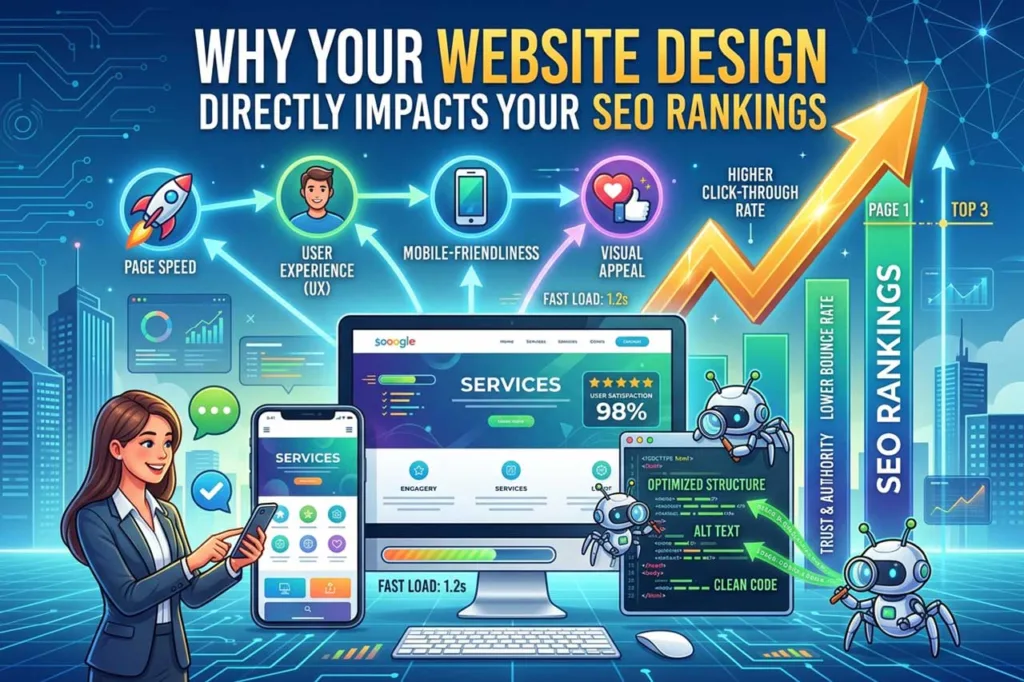
Website Design Impacts more than just first impressions—it directly influences how search engines rank your pages. Factors like page speed, mobile responsiveness, site structure, and user experience all send signals to Google that affect your visibility. This guide breaks down the specific ways design choices help or hurt your rankings, backed by data and practical fixes. By the end, you’ll know exactly which design elements to prioritize to climb the search results and keep visitors engaged.
Key Takeaways
- Website design and SEO are inseparable. Google evaluates design signals like speed, mobile-friendliness, and layout when ranking pages.
- Page speed matters immensely. According to Google, the probability of a bounce increases 32% as page load time goes from 1 to 3 seconds.
- Mobile-first indexing is the standard. Google primarily uses the mobile version of your site for indexing and ranking.
- Core Web Vitals are direct ranking factors. Metrics measuring loading, interactivity, and visual stability influence your position in search results.
- Good design improves user experience signals, such as dwell time and bounce rate, which correlate with better rankings.
How does website design affect SEO rankings?
Website design affects SEO rankings because search engines reward sites that deliver fast, accessible, and user-friendly experiences. Google’s algorithm evaluates technical design elements—load speed, mobile responsiveness, navigation structure, and layout stability—as ranking signals. A poorly designed site frustrates visitors, increases bounce rates, and signals to Google that your page may not deserve a top spot.
Search engines aim to serve the best possible result for every query. If your design creates friction—slow loading, confusing menus, or content that jumps around as the page loads—users leave quickly. Those negative behavior signals tell Google your page isn’t meeting user needs, which can push your rankings down.
Why does page speed influence your search rankings?
Page speed influences rankings because it’s both a confirmed Google ranking factor and a major driver of user behavior. Slow-loading pages lose visitors before they even see your content, and Google notices.
Google’s own research found that as page load time increases from 1 second to 3 seconds, the probability of a bounce increases by 32%. Stretch that load time to 5 seconds, and bounce probability climbs to 90%. Every extra second costs you visitors—and rankings.
Design decisions play a huge role in speed. Oversized images, bloated code, unnecessary plugins, and heavy animations all drag down load times. Streamlining these elements is one of the fastest ways to improve both user experience and rankings. For a deeper look at why loading time matters, see our guide on why website speed is important.
How can you improve your website's load speed?
- Compress and resize images using modern formats like WebP or AVIF.
- Minify CSS, JavaScript, and HTML to reduce file sizes.
- Enable browser caching so returning visitors load pages faster.
- Use a content delivery network (CDN) to serve files from servers closer to users.
- Remove unused plugins and scripts that add unnecessary weight.
Why is mobile-friendly design critical for SEO?
Mobile-friendly design is critical because Google uses mobile-first indexing, meaning it primarily crawls and ranks the mobile version of your website. If your mobile experience is broken or clunky, your rankings suffer across all devices.
More than half of global web traffic now comes from mobile devices. A design that looks great on desktop but forces mobile users to pinch, zoom, and squint will drive them away—and Google tracks that behavior. Responsive design, which automatically adapts your layout to any screen size, is the standard solution.
The stakes are high. A mobile site that loads slowly or displays poorly can undo the rest of your SEO efforts. Learn more about the growing importance of mobile optimization in our post on why you need a mobile-friendly website.
What are Core Web Vitals, and why do they matter?
Core Web Vitals are a set of specific metrics Google uses to measure real-world user experience, and they function as direct ranking signals. They focus on three areas of page performance:
| Metric | What It Measures | Good Score |
|---|---|---|
| Largest Contentful Paint (LCP) | Loading performance—how quickly the main content appears | Under 2.5 seconds |
| Interaction to Next Paint (INP) | Responsiveness—how quickly the page reacts to user input | Under 200 milliseconds |
| Cumulative Layout Shift (CLS) | Visual stability—how much the layout unexpectedly moves | Under 0.1 |
Google introduced Core Web Vitals as part of its page experience signals to reward sites that provide smooth, stable browsing. Design choices directly affect each metric. For example, images without defined dimensions cause layout shifts (hurting CLS), while heavy scripts delay interactivity (hurting INP). You can measure your scores for free using Google PageSpeed Insights.
How does site structure and navigation impact SEO?
Site structure and navigation impact SEO by determining how easily both users and search engine crawlers can find and understand your content. A clear, logical hierarchy helps Google index your pages efficiently and helps visitors reach what they need in fewer clicks.
A well-organized site uses a shallow structure—ideally, any page should be reachable within three clicks from the homepage. This approach spreads link equity across your pages and signals which content matters most. Confusing menus, orphaned pages, and broken links do the opposite, wasting crawl budget and frustrating users.
What makes good website navigation?
- Descriptive menu labels that clearly state where each link leads.
- A logical hierarchy grouping related pages under relevant categories.
- Internal linking that connects related content and guides users deeper into your site.
- Breadcrumb navigation that shows users where they are within your site.
- A working search function for content-heavy sites.
Does user experience really affect where you rank?
Yes—user experience affects rankings because Google monitors how visitors interact with your site and uses those signals to judge content quality. Metrics like dwell time, bounce rate, and pages per session reflect whether your design keeps people engaged.
When someone clicks your result, quickly leaves, and picks a different result (a behavior called “pogo-sticking”), Google interprets that as a sign your page didn’t satisfy the search intent. Clean design, readable typography, logical layout, and fast interactions all encourage visitors to stay longer and explore more—positive signals that support higher rankings.
Design elements that improve user experience include:
- Readable fonts with adequate size and contrast.
- Generous white space that prevents visual clutter.
- Clear calls to action that guide visitors toward next steps.
- Accessible design that works for users with disabilities, following WCAG accessibility guidelines.
How do design and SEO work together for better results?
Design and SEO work together when technical performance and visual appeal support the same goal: delivering value to visitors. A beautiful site that loads slowly fails at SEO, while a fast site with confusing navigation fails at conversion. The best results come from balancing both.
Think of design as the foundation that lets your content perform. Strong on-page SEO, quality content, and backlinks all matter—but if your design creates friction, those efforts underdeliver. When design and SEO align, you get a site that ranks well, converts visitors, and builds lasting authority.
Bringing it all together
Website design isn’t a separate project from SEO—it’s a core part of it. Every decision about speed, mobile responsiveness, structure, and user experience either strengthens or weakens your ability to rank. Start by auditing your current site: test your load speed, check your mobile display, review your Core Web Vitals, and walk through your navigation as a first-time visitor would.
Fixing design issues can deliver some of the fastest SEO wins available, because they improve both how search engines see your site and how real people use it. If you’re ready to build a website that ranks and converts, the team at Los Angeles SEO specializes in conversion-optimized web design paired with data-driven SEO strategy.
Frequently asked questions
Can a website redesign hurt my SEO rankings?
Yes, a redesign can hurt rankings if it’s done without SEO planning. Common pitfalls include changing URLs without redirects, removing existing content, or accidentally blocking search engines. Always work with an SEO-aware team and set up proper 301 redirects to preserve your existing rankings.
How long does it take for design changes to affect SEO?
It varies. Technical improvements like faster load speed can show results within a few weeks as Google recrawls your pages. Larger changes involving structure or content may take one to three months to fully reflect in rankings, since Google needs time to reassess your site.
Is a fast website more important than good content?
Neither works well alone. Fast, well-designed sites with thin content won’t rank for competitive terms, and excellent content on a slow, broken site won’t reach its potential. Google rewards pages that combine quality content with strong technical performance.
Do I need a custom-designed website to rank well?
Not necessarily. Many template-based sites rank well when they’re optimized for speed, mobile use, and clear structure. Custom design offers more control over performance and user experience, but a well-configured template can compete effectively for most businesses.