Two of the most debated channels in digital marketing are email and social media—and for good reason. Both can drive traffic, generate leads, and build brand awareness, but they work very differently and deliver results at different speeds and price points. This guide breaks down the ROI of each channel using real data, explains when one outperforms the other, and helps you decide where your marketing budget actually belongs.
Key Takeaways
- Email marketing consistently delivers a higher average ROI than social media, with some estimates placing the return as high as $36–$42 for every $1 spent (Litmus, 2023).
- Social media excels at brand discovery, audience building, and top-of-funnel engagement—but converting followers into paying customers is harder to measure and optimize.
- The right channel depends on your business goals: email wins for retention and direct revenue; social media wins for reach and brand awareness.
- Most high-performing digital marketing strategies use both channels together rather than choosing one over the other.
- Organic reach on major platforms like Facebook and Instagram has declined significantly, making social media increasingly pay-to-play for businesses.
What Does "ROI" Actually Mean in Digital Marketing?
Before comparing channels, it helps to define what ROI means in this context. Return on investment (ROI) in digital marketing measures the revenue generated from a channel relative to the cost of running it. The formula is straightforward:
ROI = (Revenue Generated – Cost of Campaign) ÷ Cost of Campaign × 100
However, ROI is rarely as clean as a spreadsheet makes it look. Attribution is messy. A customer might discover your brand on Instagram, receive three emails over two weeks, and then convert through a Google search. That complexity is exactly why comparing email marketing vs. social media ROI requires looking at multiple performance indicators—not just last-click revenue.
How Does Email Marketing ROI Compare to Social Media ROI?
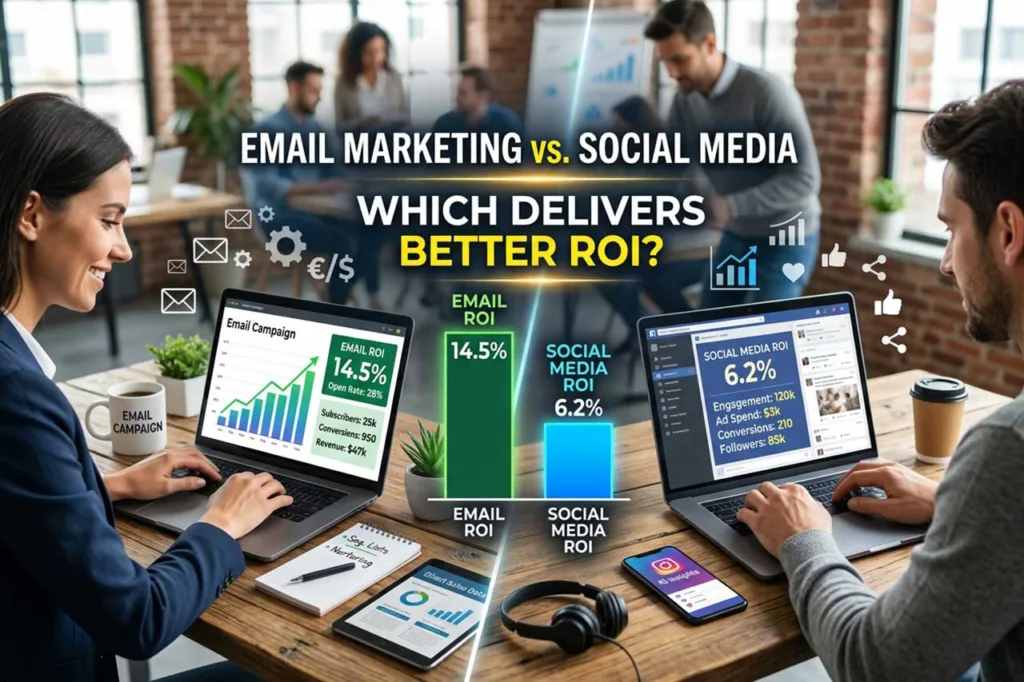
Email marketing delivers a higher average ROI than social media for most business types. According to Litmus’s 2023 State of Email report, email marketing generates an average return of $36 for every $1 spent. Some industry benchmarks push that figure closer to $42. Social media ROI is harder to quantify with precision, but HubSpot’s 2023 State of Marketing report found that only 23% of marketers rate social media as their top revenue-generating channel.
The core reason email outperforms social media on direct ROI is ownership. When someone joins your email list, that relationship belongs to your business. When someone follows you on Instagram or Facebook, that relationship belongs to Meta—and the platform controls how much of your content they actually see.
Organic Facebook reach for business pages has dropped to roughly 5% or less of total followers, according to multiple industry analyses. That means 95 out of every 100 people who follow your page may never see your post unless you pay to boost it.
| Metric | Email Marketing | Social Media |
|---|---|---|
| Average ROI | $36–$42 per $1 spent | Varies widely; harder to attribute |
| Audience ownership | Yes (your list) | No (platform-controlled) |
| Organic reach | Near 100% of subscribers | ~5% or less (Facebook/Instagram) |
| Conversion rate | 2–5% average | 0.5–1% average |
| Cost per acquisition | Lower for warm audiences | Higher due to paid amplification |
| Best use case | Retention, direct sales | Discovery, brand awareness |
Why Email Marketing Tends to Win on Direct Revenue
Email marketing’s ROI advantage comes down to three structural strengths: intent, personalization, and deliverability.
High-intent audience
People who subscribe to your email list have actively opted in. They already know who you are and want to hear from you. That warm relationship makes conversion far easier than reaching a cold social media user who stumbled across a paid ad.
Personalization at scale
Modern email platforms—Klaviyo, Mailchimp, HubSpot, ActiveCampaign—enable sophisticated segmentation. You can send different messages to first-time buyers, lapsed customers, and high-value repeat purchasers simultaneously. Social media personalization is possible through ad targeting, but it costs money every time.
Reliable delivery
When you send an email to a subscriber, it arrives in their inbox. Barring spam filters (which good email hygiene minimizes), your message reaches its intended destination. Social media posts compete with every other piece of content in a user’s feed, an algorithm decides visibility, and that algorithm’s priorities change constantly.
For businesses focused on retention, upselling, and lifecycle marketing, email is difficult to beat. If you’re running an e-commerce store, a SaaS product, or a local service business, your existing customer list is one of your most valuable assets—and email is how you activate it.
Where Social Media Has the Clear Advantage
Social media isn’t losing the ROI debate because it’s ineffective. It wins in areas where email simply cannot compete.
Brand discovery and top-of-funnel reach
New customers can’t join your email list if they don’t know you exist. Social media—particularly Instagram, TikTok, LinkedIn, and YouTube—is where discovery happens. Short-form video content, user-generated posts, and influencer partnerships can introduce your brand to thousands of people who have never heard of you. That kind of reach is nearly impossible to replicate with email alone.
Community building and social proof
Reviews, comments, shares, and user-generated content create trust signals that email cannot replicate. Seeing real customers talk about your product in public is one of the most powerful conversion drivers in digital marketing. Social media makes this visible and shareable.
B2B relationship development
LinkedIn is a particularly strong ROI channel for B2B businesses. According to LinkedIn’s own data, LinkedIn is 277% more effective at generating leads than Facebook for B2B audiences. For agencies, consultants, and service providers, LinkedIn content and outreach can produce high-value opportunities that email alone wouldn’t surface.
Viral and organic growth potential
A single piece of genuinely compelling content—a tutorial, a behind-the-scenes video, a bold opinion—can spread organically across social platforms at no cost. Email has no equivalent mechanism. Social media’s ceiling for organic amplification is far higher, even if the floor (reliable reach) is lower.
Email vs. Social Media by Business Type: Which Should You Prioritize?
The right channel allocation depends heavily on your business model, customer lifecycle, and current marketing maturity.
Prioritize email marketing if you:
- Run an e-commerce business with an existing customer base
- Sell a subscription product or service
- Have a longer sales cycle and need to nurture leads over time
- Want to reduce dependency on paid advertising
- Are working with a limited marketing budget and need predictable ROI
Prioritize social media if you:
- Are launching a new brand with no existing audience
- Sell visually driven products (fashion, food, interiors, fitness)
- Need to build brand awareness quickly in a competitive market
- Are targeting younger demographics (Gen Z and younger millennials)
- Operate in a B2B space where LinkedIn thought leadership matters
Use both strategically if you:
- Have the resources to invest in both channels
- Want to build a full-funnel marketing strategy
- Are running content marketing campaigns that can feed both channels
- Need both acquisition (social) and retention (email) working simultaneously
Understanding how to build a content strategy that drives organic traffic can help you create content that performs well across both email and social channels without doubling your production workload.
How to Measure ROI for Each Channel Accurately
Measuring ROI accurately requires tracking the right metrics—and resisting the temptation to optimize for vanity metrics, such as follower counts or open rates, in isolation.
Email marketing metrics that matter
- Revenue per email sent: Total revenue generated divided by emails sent
- Conversion rate: Percentage of recipients who completed a purchase or desired action
- Customer lifetime value (CLV) by acquisition source: Are email-acquired customers worth more over time?
- List growth rate: A shrinking list signals a problem upstream
- Unsubscribe and spam complaint rates: High rates indicate poor targeting or content relevance
Social media metrics that matter
- Cost per acquisition (CPA): How much you’re spending in paid ads to acquire one customer
- Return on ad spend (ROAS): Revenue generated for every dollar spent on social ads
- Click-through rate (CTR): Measures how compelling your content or ads are
- Engagement rate: Likes, comments, and shares as a percentage of reach
- Follower-to-customer conversion rate: What percentage of your followers actually buy?
To connect social media activity to real revenue, use UTM parameters on all social links and configure proper conversion tracking in Google Analytics 4. Without this infrastructure, attributing revenue to social media is largely guesswork. Understanding 10 common SEO mistakes—and how to fix them also highlights why tracking and attribution are foundational, not optional, parts of any digital marketing strategy.
The Case for Integrating Both Channels
The most effective marketing strategies don’t treat email and social media as competitors. They use them as complementary layers of the same customer journey.
A practical integration framework looks like this:
- Use social media to attract new audiences through organic content, paid ads, and influencer partnerships.
- Convert social followers into email subscribers by offering lead magnets, exclusive content, or discounts in exchange for an email address.
- Nurture subscribers through email sequences that build trust, demonstrate value, and guide them toward a purchase.
- Retarget email subscribers on social media using custom audience uploads on Facebook and Instagram to reinforce your message across channels.
- Re-engage lapsed customers through both email win-back sequences and social retargeting ads.
This integrated approach captures the brand-building power of social media and the conversion efficiency of email—without sacrificing one for the other. According to HubSpot’s 2024 Marketing Report, marketers who use integrated multi-channel strategies see 3x higher engagement rates than those relying on a single channel.
For businesses looking to scale their digital presence, the Digital Marketing 2026 Roadmap offers a broader framework for aligning these channels with long-term growth objectives.
What the Data Says About Paid Social vs. Email in 2024–2026
Paid social advertising has grown dramatically more expensive over the past five years. According to Wordstream’s 2024 industry benchmarks, the average cost per click (CPC) across Facebook and Instagram ads rose by approximately 89% between 2019 and 2024. As platforms become more crowded and ad inventory more competitive, the cost of acquiring new customers through paid social continues to climb.
Email marketing costs, by contrast, remain relatively stable. Once a subscriber is on your list, the incremental cost of sending them a campaign is negligible. A well-maintained email list of 10,000 subscribers can generate consistent revenue with a monthly platform cost of under $200 on most mid-tier tools.
This cost stability is why email marketing ROI tends to improve over time as your list grows, while social media ROI often plateaus or declines as competition for ad space increases.
Which Channel Delivers Better ROI? The Honest Answer
Email marketing delivers higher, more measurable, and more consistent direct ROI for most businesses—particularly those with an existing audience, a defined product, and a focus on retention and repeat purchases.
Social media delivers better ROI for brand discovery, audience growth, and top-of-funnel visibility—especially for businesses entering new markets or launching new products.
The most accurate answer is that neither channel delivers its best ROI in isolation. Email converts better when it’s fed by a social audience. Social ads perform better when retargeting a warm email list. The ROI ceiling for both channels is highest when they work together.
Build a Strategy That Works Across Both Channels
The debate between email marketing and social media often distracts from the real question: are you using both channels as effectively as possible? Email wins on direct revenue and predictability. Social media wins on reach and discovery. A coordinated strategy built around the customer journey—from first impression to loyal repeat buyer—is what separates high-growth brands from those stuck chasing platform algorithms.
If you’re unsure where your current digital marketing strategy has gaps, a comprehensive audit can reveal where effort and spend are misaligned with results. Los Angeles SEO Inc specializes in data-driven digital marketing strategies that integrate content, SEO, email, and paid channels into a unified growth framework. Get your free strategy consultation today to see where your biggest opportunities lie.
Frequently Asked Questions
Is email marketing more effective than social media for generating sales?
Yes, for most business types. Email marketing generates an average ROI of $36–$42 per $1 spent, compared to social media, where direct revenue attribution is more difficult and conversion rates are generally lower (averaging 0.5–1% for social vs. 2–5% for email). Email’s advantages include audience ownership, personalization, and reliable delivery.
Why does social media have lower ROI than email despite its massive reach?
Social media reach is controlled by platform algorithms. Organic reach on Facebook and Instagram pages has declined to roughly 5% or less of total followers. This means most businesses must pay to reach their own audience through ads, increasing costs. Email, by contrast, delivers directly to subscribers at minimal incremental cost.
Can a small business afford to invest in both email and social media marketing?
Yes. Most email platforms offer affordable entry-level plans for small lists, and organic social media requires only time and content creation. The most budget-efficient approach for small businesses is to use organic social to grow an email list, then focus conversion efforts through email campaigns.
How do you track ROI for social media marketing accurately?
Accurate social media ROI tracking requires UTM parameters on all links, conversion tracking in Google Analytics 4, and platform-specific pixel or tag installation (Meta Pixel, LinkedIn Insight Tag). Without these, you’re measuring activity, not outcomes. ROAS (return on ad spend) is the most direct metric for paid social, while organic social ROI requires tracking assisted conversions.
What is the best email marketing platform for small to mid-sized businesses?
Mailchimp, Klaviyo, and ActiveCampaign are three of the most widely used platforms for small to mid-sized businesses. Klaviyo is particularly strong for e-commerce, ActiveCampaign excels at automation and CRM integration, and Mailchimp offers a generous free tier for businesses just starting out.
Should I stop investing in social media if my email list performs better?
No. Even if email delivers higher direct ROI, social media serves a different function—brand discovery and audience growth. Without continued social media presence, your email list will eventually stop growing. Use social media to attract new subscribers and email to convert and retain them.
How long does it take to see ROI from email marketing vs. social media?
Email marketing can show measurable ROI within weeks, especially if you have an existing list and a clear offer. Social media takes longer—building a meaningful organic following can take 6–12 months, while paid social can show results faster but requires a consistent budget. The long-term ROI of a well-maintained email list typically exceeds social media investment over a 12–24-month horizon.