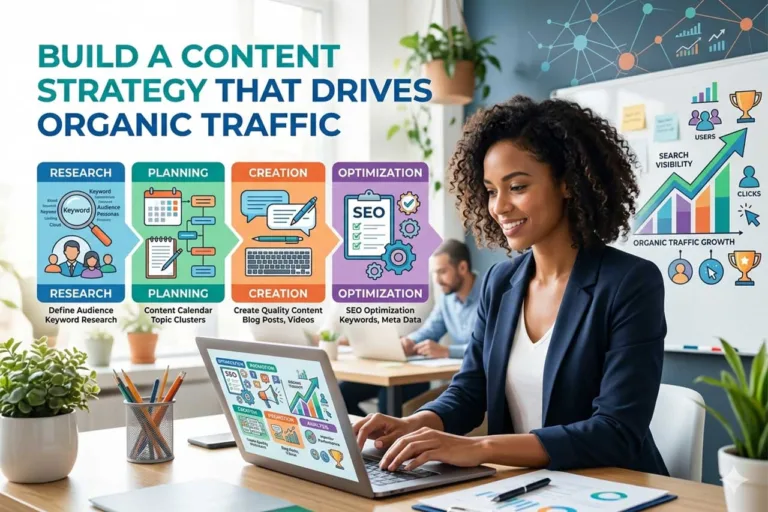
A well-built content strategy is one of the most reliable ways to grow organic traffic—without relying on paid ads. This guide walks you through every core step, from defining your goals to publishing content that ranks, answers real questions, and keeps compounding in value over time. Whether you’re starting from scratch or fixing a strategy that’s stalled, you’ll leave with a clear, actionable framework to follow.
Key Takeaways
- Organic search accounts for 53% of all trackable website traffic, making it the single largest driver of visitors for most businesses (BrightEdge).
- A content strategy without keyword research is essentially guesswork—search intent must guide every piece you publish.
- Content that answers specific questions performs better in both traditional search engines and AI-generated results (AEO/GEO).
- Consistency and internal linking structure matter as much as individual article quality.
- Tracking the right metrics—not just traffic, but engagement and conversions—is what separates effective strategies from busy ones.
What Is a Content Strategy, and Why Does Organic Traffic Depend on It?
A content strategy is a documented plan for creating, publishing, and managing content to meet specific business goals. For most websites, the primary goal is generating organic traffic—visitors who find your site through unpaid search results.
According to BrightEdge research, organic search drives 53% of all trackable website traffic. Social media, by comparison, accounts for just 5%. Those numbers illustrate why building a strategy centered on organic search is a smart long-term investment. Paid ads stop working the moment you stop paying. Organic content keeps delivering.
A strong content strategy gives every article, guide, and landing page a job to do—and a reason to exist.
Step 1: Define Your Goals Before You Write a Single Word
Before choosing topics or formats, get clear on what success looks like for your website. Vague goals produce vague content.
Ask yourself:
- Are you trying to generate leads, build brand awareness, or increase e-commerce sales?
- What does a “win” look like in 6 months? 12 months?
- Which pages on your site are currently underperforming?
Map every content goal to a measurable KPI. For example:
- Brand awareness goal → Track organic impressions and new users
- Lead generation goal → Track form submissions and conversion rate from organic traffic
- E-commerce goal → Track organic-assisted revenue
For a deeper breakdown of which numbers actually matter, see Los Angeles SEO Inc.’s guide on key SEO metrics every business owner should track.
Step 2: Research Your Audience and Their Search Intent
Knowing your audience means knowing what they type into Google—and why. Search intent is the reason behind a query. Get this wrong, and even well-written content won’t rank.
There are four core types of search intent:
| Intent Type | What the User Wants | Example Query |
|---|---|---|
| Informational | To learn something | “What is a content strategy?” |
| Navigational | To find a specific site | “Los Angeles SEO Inc. blog” |
| Commercial | To compare options | “Best SEO agencies in LA” |
| Transactional | To take action | “Hire an SEO agency” |
Your content mix should serve all four, but informational content typically drives the most top-of-funnel organic traffic. Build content around the questions your audience is already asking.
Step 3: Conduct Keyword Research to Find Real Opportunities
Keyword research is the backbone of any organic content strategy. Tools like Ahrefs, Semrush, and Google Search Console help you identify:
- Search volume: How often a keyword is searched monthly
- Keyword difficulty: How hard it is to rank for that term
- Search intent alignment: Whether the results match your content type
According to Ahrefs’ SEO statistics, the first organic result on Google earns the highest click-through rate by a wide margin. This reinforces one core truth: ranking on page two is practically invisible.
Prioritize long-tail keywords—phrases of three or more words—especially when your domain authority is still growing. These queries have lower competition and attract users who know what they’re looking for.
Step 4: Build a Content Plan Around Pillar Pages and Clusters
A topic cluster model organizes your content strategically. One broad “pillar page” covers a major topic at a high level. Multiple “cluster” articles cover related subtopics in depth and link back to the pillar.
Example:
- Pillar page: Complete Guide to SEO for Small Businesses
- Cluster articles: Local SEO tips, how to choose keywords, how to build backlinks, on-page SEO checklist
This structure helps search engines understand your site’s topical authority. It also makes navigation intuitive for readers, reducing bounce rates and increasing time on site.
When planning your cluster content, ask: “What specific question does this article answer?” If the answer is vague, the article idea needs refining.
Step 5: Create Content That Satisfies Search Intent and E-E-A-T
Google’s quality guidelines are built around E-E-A-T: Experience, Expertise, Authoritativeness, and Trustworthiness. Content that ticks these boxes earns better rankings and builds real credibility with your audience.
To produce content that meets these standards:
- Lead with the answer. State the core point upfront, then support it with evidence.
- Cite verifiable sources. Use named studies, data, and sources readers can check.
- Include author credentials. A byline with relevant experience signals expertise.
- Update content regularly. Stale content loses rankings over time.
For a full breakdown of how E-E-A-T impacts your rankings, read Los Angeles SEO Inc.’s guide on Google’s E-E-A-T guidelines and SEO benefits.
Step 6: Optimize On-Page SEO for Every Article
Publishing a great article without on-page optimization is like building a billboard in a field nobody drives through. Here’s what to include in every piece of content:
- Target keyword in the H1 headline and first 100 words
- Descriptive H2 and H3 subheadings that reflect what each section covers
- Meta title and meta description optimized with the target keyword
- Internal links to relevant pages on your site
- Image alt text with descriptive, keyword-aware language
- Short, readable paragraphs (aim for a Flesch reading-ease score of 60 or above)
Step 7: Earn Backlinks to Boost Your Authority
Content alone won’t rank in competitive spaces. Backlinks—links from other websites to yours—signal to Google that your content is credible and worth referencing.
Effective backlink strategies include:
- Publishing original research or data that others want to cite
- Writing guest articles on relevant industry publications
- Earning editorial mentions by producing genuinely useful, comprehensive guides
Not all links are created equal. A single link from a trusted, high-authority website is worth more than dozens of low-quality links. Before pursuing any link-building tactic, understand the difference between good backlinks and toxic links.
Step 8: Measure, Analyze, and Iterate
A content strategy is never truly finished. Performance data tells you what’s working and what needs attention. Review your analytics monthly and look for:
- Pages gaining organic impressions but not clicks: Optimize the meta title and description
- High-traffic pages with low conversion rates: Improve the call-to-action or content structure
- Articles that ranked and then dropped: Update them with fresh information and stronger internal linking
The goal is steady, compounding growth—not overnight spikes.
Turn Your Content Into Your Best Sales Tool
A content strategy built around organic traffic isn’t just a marketing tactic. It’s a long-term asset that generates leads, builds authority, and compounds in value every month. The brands that grow consistently online are the ones that treat content as an investment, not an afterthought.
Start by auditing what you currently have. Identify the gaps. Build your keyword list. Then create content that actually answers the questions your audience is searching for. Small, consistent improvements add up faster than most people expect.
Los Angeles SEO Inc. has helped 500+ businesses build content strategies that drive real organic growth since 2013. If you’d like expert help building or optimizing yours, contact our team today.
Frequently Asked Questions
How long does it take for a content strategy to drive organic traffic?
Most websites begin to see measurable organic traffic growth within 3 to 6 months of consistently publishing optimized content. Competitive niches may take longer. The timeline depends on your domain authority, publishing frequency, keyword difficulty, and how well your content matches search intent.
How many pieces of content do I need to publish each month?
There’s no universal number. Quality outweighs quantity every time. One well-researched, properly optimized long-form article per week will outperform five thin, rushed posts. Focus on publishing consistently and covering your target topics thoroughly before scaling volume.
Do I need to hire an SEO agency to build a content strategy?
Not necessarily. Businesses with internal marketing resources can build effective content strategies using tools like Ahrefs, Semrush, or Google Search Console. An SEO agency becomes valuable when you need to scale faster, lack in-house expertise, or compete in a high-difficulty niche where technical precision matters.
What types of content drive the most organic traffic?
Long-form guides, how-to articles, comparison posts, and FAQ pages consistently perform well in organic search. These formats align with informational and commercial search intent, which represent the majority of queries. Video transcripts and case studies also help capture additional keyword opportunities.
Is social media a substitute for an organic content strategy?
No. Social media drives approximately 5% of trackable website traffic, compared to 53% from organic search (BrightEdge). Social content has a short shelf life; organic content keeps attracting visitors for months or years. A social presence can amplify content reach, but it cannot replace the compounding value of a well-structured SEO content strategy.