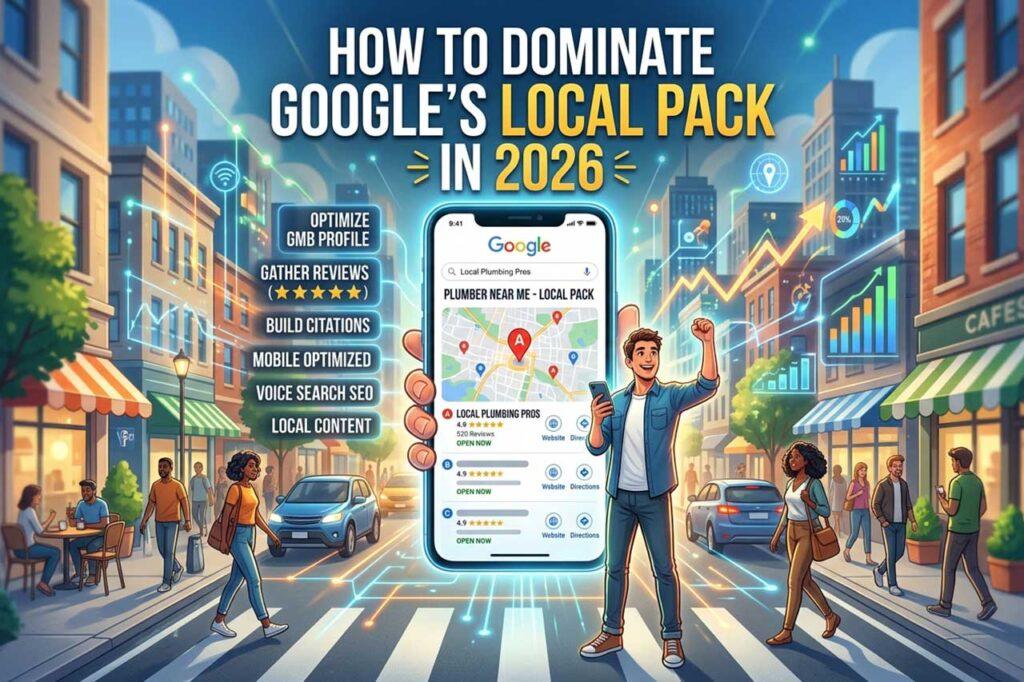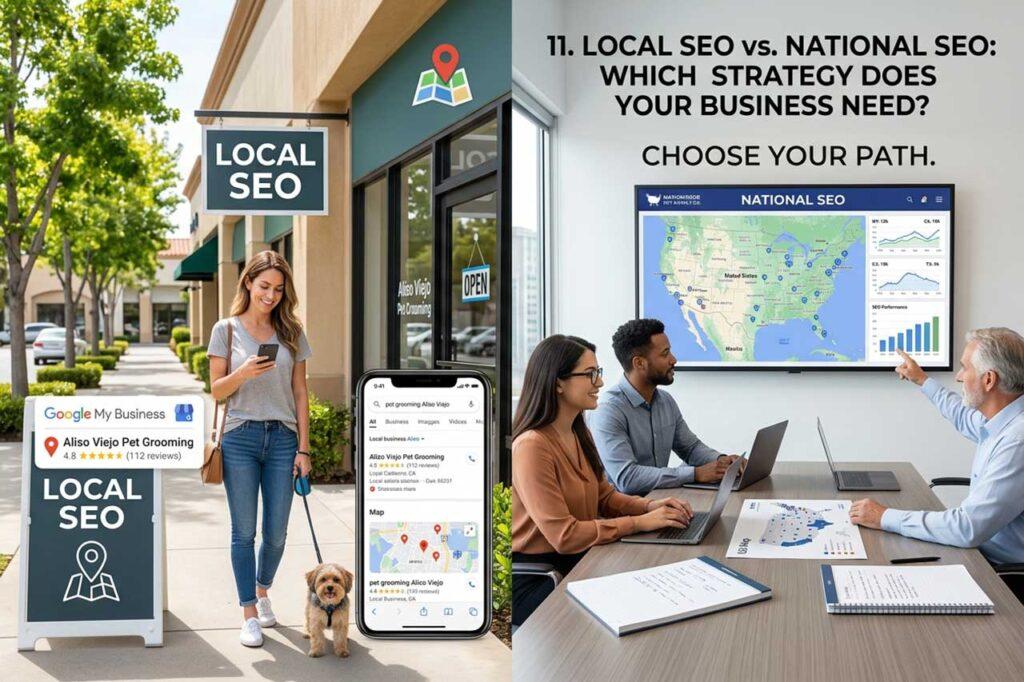

Local SEO is defined as the practice of optimizing a business’s digital assets to appear prominently in geographically tied searches like “plumber near me” or “best coffee shop in Austin.” It covers your website, Google Business Profile, local citations, and online reviews. Nearly 46% of all Google searches carry local intent. That number means roughly half of every search on Google is an opportunity for a nearby business to win a customer. Local search optimization connects you with real buyers at the exact moment they are ready to act, whether they find you through Google Search, Google Maps, or AI discovery tools like Perplexity.
What is local SEO and how does it differ from traditional SEO?
Local SEO focuses on geographic intent and getting your business into map-based and localized search results. Traditional SEO targets broad or national queries, relying primarily on website content quality and backlink authority to rank. Both disciplines share foundational tasks like keyword research and on-page optimization, but local search optimization adds a layer of location-specific signals that general SEO simply does not require.
The table below shows the clearest practical differences between the two approaches.
| Factor | Local SEO | Traditional SEO |
|---|---|---|
| Primary goal | Appear in map packs and local results | Rank for broad or national queries |
| Key ranking signals | Google Business Profile, citations, reviews | Backlinks, content authority, site structure |
| Search results format | Local Pack (3-Pack), Google Maps | Standard organic blue links |
| Geographic targeting | City, neighborhood, or region | National or global |
| Audience intent | “Near me” or location-specific | Informational, commercial, or navigational |
The core distinction comes down to intent. When someone searches “emergency dentist Chicago,” they want a local result fast. Google knows this and surfaces a map pack above organic results. Traditional SEO tactics alone will not get you into that map pack. You need the full set of local signals working together.
Key signals that separate local SEO from traditional SEO include:
- Google Business Profile completeness: Categories, hours, photos, and service areas all feed directly into local rankings.
- Citation consistency: Your business name, address, and phone number must match exactly across directories like Yelp, Yellow Pages, and Apple Maps.
- Review volume and recency: Fresh, positive reviews signal trust and relevance to Google’s local algorithm.
- Proximity: Google factors in how close your business is to the searcher at the time of the query.
One often-overlooked reality is that location personalization means two people searching the same keyword in the same city can see completely different results. A searcher in downtown Los Angeles and one in the San Fernando Valley will see different local packs for “Italian restaurant.” This dynamic makes local SEO a moving target that requires ongoing attention, not a one-time setup.
What are the core components of local SEO?
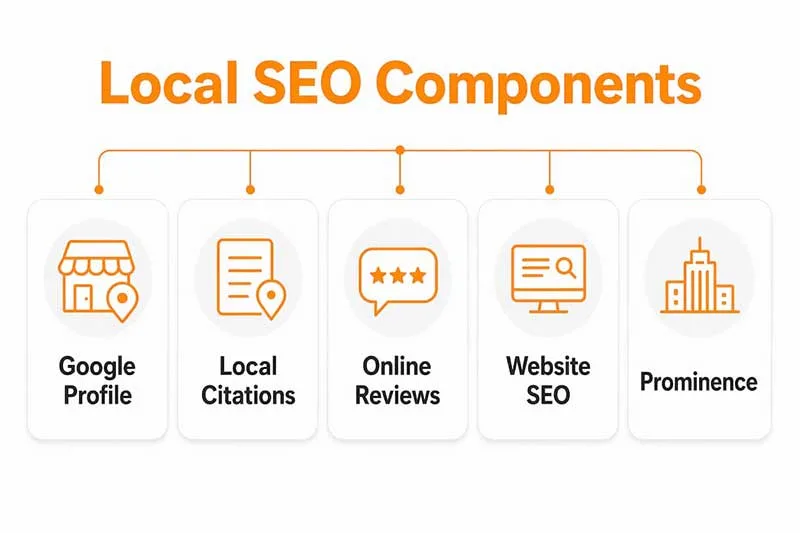
Local pack visibility is powered by a combination of Google Business Profile data, citations, reviews, and website signals working as a system. No single element dominates. Google weighs all of them together to decide which businesses earn prominent placement.
Google business profile
Your Google Business Profile (GBP) is the single most influential asset in local search. A complete and accurate GBP tells Google exactly what your business does, where it operates, and when it is open. Businesses with fully completed profiles, including photos, service descriptions, and regular posts, consistently outperform those with sparse or outdated information. Treat your GBP like a living storefront, not a one-time form you fill out and forget.
Local citations
A local citation is any online mention of your business name, address, and phone number (NAP). Citations appear on directories like Yelp, Bing Places, TripAdvisor, and industry-specific platforms. Consistency is the operative word here. If your address appears as “Suite 100” on your website but “Ste. 100” on Yelp, Google reads that as a discrepancy. Discrepancies erode trust and suppress your local rankings. Audit your citations regularly using tools like BrightLocal or Semrush’s Listing Management to catch and correct inconsistencies.
Online reviews and reputation
Reviews are both a ranking signal and a conversion signal. Google uses review volume, average rating, and recency to assess your business’s prominence. A business with 200 reviews averaging 4.6 stars will almost always outrank a competitor with 15 reviews at 4.9 stars. Beyond rankings, reviews influence whether a searcher clicks on your listing at all. Responding to reviews, both positive and negative, demonstrates active management and builds credibility with potential customers.
Website optimization for local relevance
Your website reinforces the signals your GBP and citations send. Location-specific landing pages, locally relevant content, and schema markup (structured data that tells Google your business type, location, and hours) all strengthen your local relevance. A plumber serving three cities should have a dedicated page for each city, not a single generic service page. Each page gives Google a clear geographic signal and gives searchers a relevant landing experience.
Pro Tip: Add LocalBusiness schema markup to your website’s homepage and location pages. This structured data helps Google extract your NAP details accurately and can improve how your business appears in rich search results.
How does the google local pack work?
The Google Local Pack, commonly called the 3-Pack, is the block of three business listings that appears at the top of local search results, above organic links. It includes the business name, star rating, address, hours, and a link to Google Maps. Visibility in the Local Pack correlates with 126% more traffic and 93% more user actions compared to businesses not featured. That is not a marginal advantage. It is the difference between being found and being invisible.
Google customizes local results based on the physical location of the searcher at the time of the search. This means local search results vary dynamically by location and time, making a single device ranking check an unreliable measure of your actual local performance. A business that ranks first in the 3-Pack for a user two blocks away may not appear at all for a user a mile in the other direction.
The three primary factors Google uses to rank businesses in the Local Pack are:
- Relevance: How well your business profile matches the searcher’s query.
- Distance: How close your business is to the searcher’s location.
- Prominence: How well-known and trusted your business is, based on reviews, citations, links, and overall online presence.
Prominence is the factor you have the most control over. Building a strong review profile, earning local backlinks from community organizations or local news sites, and maintaining consistent citations all increase your prominence score over time.
One practical note: the Local Pack order does not mirror organic search rankings. A business can rank in position 8 organically but appear in the top 3 of the Local Pack. This is why local search optimization deserves its own dedicated strategy, separate from your broader SEO efforts.
How do you perform a local SEO audit?
A local SEO audit evaluates your business across listing accuracy, Google Business Profile completeness, reputation, keyword rankings, content, and backlinks to identify issues that limit your visibility. Think of it as a health check for your entire local online presence. Running one every quarter gives you a clear picture of where you stand and what to fix next.
Here is a practical step-by-step process for conducting your own local SEO audit:
- Check your Google Business Profile. Verify that your business name, address, phone number, website URL, hours, and categories are accurate and complete. Look for duplicate listings and remove them.
- Audit your local citations. Use a tool like BrightLocal or Semrush to scan major directories for NAP inconsistencies. Fix any mismatches you find, starting with high-authority directories like Yelp, Bing Places, and Apple Maps.
- Evaluate your online reputation. Count your total reviews, calculate your average rating, and check when your most recent review was posted. Identify patterns in negative feedback that point to real business issues.
- Review your keyword rankings by location. Use a rank-tracking tool that supports local tracking, such as BrightLocal or Whitespark, to see where you rank for your target keywords across different neighborhoods or zip codes.
- Assess your website’s local signals. Check for location-specific landing pages, LocalBusiness schema markup, and mobile load speed. Google’s PageSpeed Insights gives you a free baseline score.
- Analyze your local backlink profile. Look for links from local chambers of commerce, community blogs, local news outlets, and industry associations. These carry strong geographic relevance signals.
Prioritize foundational elements first, specifically listing accuracy and profile completeness. A strong website cannot compensate for a GBP with wrong hours or a phone number that no longer works. Fix the foundation before addressing content or backlinks.
Pro Tip: Use The SEO Agent’s local SEO checklist for small businesses as a structured reference when running your audit. It covers every major category in a format you can work through systematically.
Key takeaways
Local SEO success requires consistent, trustworthy signals across your Google Business Profile, citations, reviews, and website working together as a system.
| Point | Details |
|---|---|
| Local SEO targets geographic intent | Optimize for map packs and location-specific queries, not just broad organic rankings. |
| Google Business Profile is foundational | A complete, accurate GBP is the single most influential asset in local search rankings. |
| Citation consistency matters | Mismatched NAP data across directories suppresses your local visibility and erodes trust. |
| Local Pack drives outsized traffic | Appearing in the 3-Pack delivers 126% more traffic than businesses outside it. |
| Audits reveal hidden visibility gaps | Quarterly local SEO audits uncover listing errors, reputation issues, and ranking blind spots. |
Local SEO is an ecosystem, not a single switch
I have worked with dozens of business owners who came to me convinced that one fix would solve their local visibility problem. They wanted to update their GBP category or get ten more reviews and call it done. That mindset consistently leads to disappointment.
What I have found after years of working on local search is that local SEO is an ecosystem of data signals, not a checklist you complete once. Your GBP, your citations, your reviews, and your website all talk to each other in Google’s algorithm. Strengthening one while neglecting the others produces limited results.
The other misconception I see constantly is the obsession with ranking number one. Business owners track their position on a single device and treat it as gospel. But single-device rankings are unreliable for measuring local SEO success because results shift based on where and when someone searches. I tell clients to measure performance across multiple locations and over a rolling 90-day window. That gives you a real picture of your visibility, not a snapshot that changes every time you move a block.
The businesses that win in local search are not the ones chasing tricks. They are the ones that build consistent relevance and prominence signals over time, respond to every review, keep their information accurate, and create content that genuinely serves their local community. That approach compounds. Shortcuts do not.
— Sasan Raeisi
Ready to improve your local search visibility?
Understanding local SEO is the first step. Executing it consistently across your GBP, citations, reviews, and website is where most business owners need support.
Los Angeles SEO Inc specializes in local SEO services for businesses that want to appear where their customers are searching. From full local SEO audits to ongoing optimization and reputation management, the team at Los Angeles SEO Inc handles the technical and strategic work so you can focus on running your business. Whether you are a single-location shop or a multi-location brand, a data-driven local SEO strategy built by experienced professionals delivers measurable results. Reach out to Los Angeles SEO Inc. to find out what is holding back your local rankings.
FAQ
What is local SEO in simple terms?
Local SEO is the process of optimizing your business’s online presence so it appears in search results when nearby customers look for your products or services. It covers your Google Business Profile, website, citations, and reviews.
How does local SEO differ from regular SEO?
Regular SEO targets broad or national search queries using website content and backlinks. Local SEO adds geographic signals like Google Business Profile data, local citations, and proximity to rank in map packs and location-specific results.
What is a local SEO audit?
A local SEO audit is a structured review of your business’s local online presence, covering listing accuracy, GBP completeness, reviews, keyword rankings, and backlinks to identify and fix visibility issues.
How long does local SEO take to show results?
Most businesses see measurable improvements in local rankings within 3–6 months of consistent optimization. Results depend on your market’s level of competition, the current state of your GBP and citations, and the quality of your review profile.
Why does my local ranking change depending on where i search?
Google personalizes local results based on the searcher’s physical location at the time of the query. Two people searching the same keyword in different parts of the same city will often see different local packs, which is why tracking rankings across multiple locations gives a more accurate performance picture.