Not all backlinks help your website rank—some actively drag it down. Understanding the difference between a high-quality backlink and a toxic one is one of the most important skills in SEO, and getting it wrong can cost you traffic, rankings, and Google’s trust. This guide breaks down exactly what separates a valuable link from a harmful one, how to identify each, and what to do if your site has already accumulated toxic links.
Key Takeaways
- Good backlinks come from authoritative, relevant websites and signal trust to search engines.
- Toxic backlinks come from spammy, irrelevant, or manipulative sources and can trigger Google penalties.
- Link quality is determined by factors like domain authority, topical relevance, and anchor text.
- Regular backlink audits are essential for maintaining a healthy link profile.
- Disavowing toxic links through Google Search Console is the recommended fix for harmful backlinks.
What Makes a Backlink "Good"?
A good backlink is an endorsement from a credible, relevant source. When a reputable website links to yours, it signals to Google that your content is trustworthy and worth surfacing in search results. According to Moz, backlinks remain one of the top-ranking factors in Google’s algorithm.
Here’s what a high-quality backlink looks like:
- High Domain Authority (DA): Links from established websites with strong DA scores carry significantly more weight.
- Topical relevance: A link from a marketing blog to a marketing agency matters far more than a link from an unrelated niche.
- Natural anchor text: The clickable text used in the link is descriptive and contextually appropriate, not overly keyword-stuffed.
- Editorial placement: The link appears organically within the content—not buried in a footer or forced into a sidebar.
- Dofollow status: Dofollow links pass “link equity” (also called PageRank) to your site, while nofollow links do not.
What Types of Websites Produce the Best Backlinks?
The strongest backlinks typically come from:
| Source Type | Why It’s Valuable |
|---|---|
| News and media outlets | High authority, wide reach |
| Industry-specific blogs | Topical relevance, engaged audience |
| Government and educational sites (.gov/.edu) | Extremely high trust signals |
| Established business directories | Consistent, verified citations |
| Partner or vendor websites | Natural, relationship-based linking |
A single link from a respected industry publication can outperform dozens of links from low-quality directories. Quality always wins over quantity.
What Makes a Backlink "Toxic"?
Toxic backlinks are links that violate Google’s Webmaster Guidelines—either because they come from low-quality sources or because they were acquired through manipulative tactics. These links can dilute your site’s authority or, in severe cases, result in a manual penalty from Google.
Common characteristics of toxic backlinks include:
- Links from link farms or Private Blog Networks (PBNs): Sites created solely to generate backlinks with no real content or audience.
- Irrelevant or foreign-language spam: Links from websites that have no thematic connection to your industry.
- Over-optimized anchor text: Repeated use of exact-match keywords in anchor text is a red flag for manipulation.
- Paid links that pass PageRank: Exchanging money for dofollow links is a direct violation of Google’s policies.
- Links from penalized domains: If the linking site has already been penalized by Google, that association can harm you too.
How Do Toxic Backlinks Hurt Your Rankings?
Google’s Penguin algorithm update, first rolled out in 2012 and now integrated into Google’s core algorithm, was specifically designed to devalue and penalize manipulative link-building practices. Sites with a high concentration of toxic links may experience:
- A sudden drop in organic rankings
- A manual action notice in Google Search Console
- Long-term loss of domain authority
If you’ve noticed an unexplained drop in traffic, your backlink profile is one of the first places to investigate. Our guide on diagnosing SEO ranking drops walks through this process step by step.
How to Audit Your Backlink Profile
Running a backlink audit helps you understand the health of your link profile before problems escalate. Here’s a straightforward process:
- Use an SEO tool: Platforms like Ahrefs or SEMrush provide a full list of your inbound links, along with spam scores and domain ratings.
- Sort by spam score: Filter links with a high spam score (above 30–40% on Moz’s scale) for closer review.
- Evaluate each link manually: Check whether the linking site is legitimate, relevant, and has real traffic.
- Flag toxic links: Document any links that meet the toxic criteria outlined above.
- Attempt removal first: Reach out to the webmaster of the linking site and request removal.
- Disavow what remains: Upload a disavow file to Google Search Console for any links you can’t get removed.
Regular audits—at least once per quarter—are a best practice for any site actively building links. For a deeper look at link-building strategy, see our full breakdown of white-hat link-building techniques.
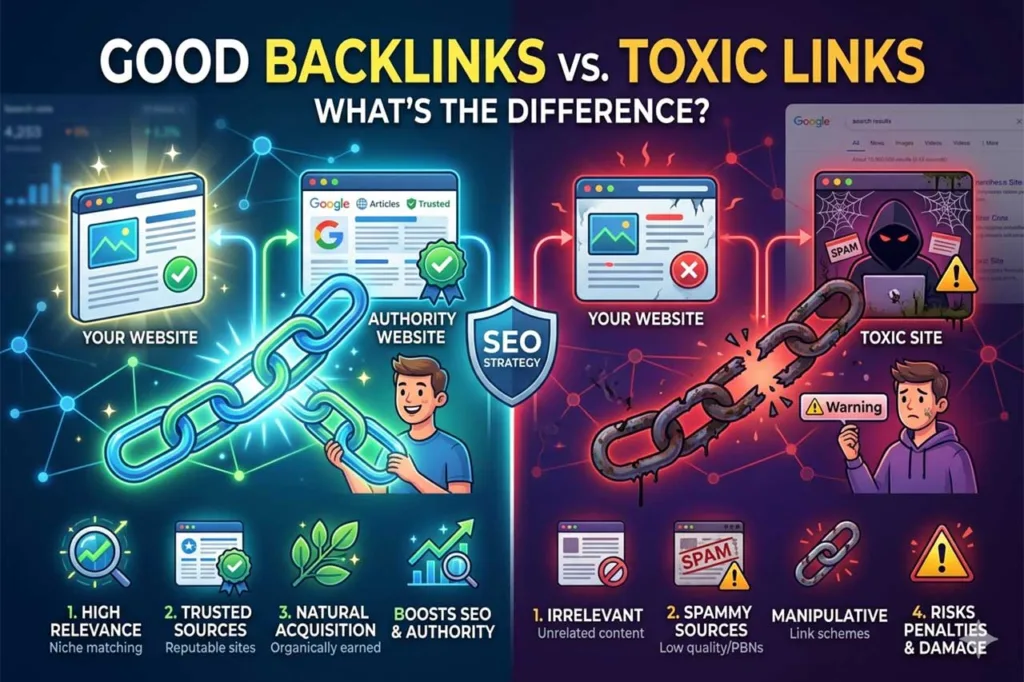
High Quality or Good Backlinks vs. Toxic Backlinks: A Side-by-Side Comparison
| Factor | Good Backlink | Toxic Backlink |
|---|---|---|
| Source quality | High DA, legitimate website | Low DA, spam or PBN site |
| Relevance | Topically related | Unrelated niche |
| Anchor text | Natural, varied | Exact-match, keyword-stuffed |
| Placement | Editorial, within content | Footer, sidebar, or hidden |
| Acquisition method | Earned or outreach-based | Paid, exchanged, or farmed |
| Impact on rankings | Positive | Neutral to harmful |
How to Build a Healthy, Sustainable Backlink Profile
The best defense against toxic links is a proactive, quality-focused link-building strategy. Tactics that consistently produce strong, natural backlinks include:
- Creating original research or data studies: Journalists and bloggers actively seek statistics to cite.
- Publishing comprehensive guides: Long-form, authoritative content earns links over time.
- Digital PR campaigns: Getting featured in local or industry press builds both links and brand authority.
- Guest posting on relevant sites: Contributing expert content to established publications in your niche.
- Broken link building: Finding dead links on reputable sites and suggesting your content as a replacement.
Each of these methods produces links that are earned, relevant, and built to last—exactly what Google rewards.
Build Links That Actually Help You Rank
The difference between a good backlink and a toxic one comes down to intent and quality. Links earned through genuine value—great content, real relationships, and relevant expertise—build lasting authority. Links manufactured through shortcuts create risk.
If your site hasn’t had a backlink audit recently, now is the time. Start by pulling your link profile in Ahrefs or SEMrush, flagging anything suspicious, and making disavowal a regular part of your SEO maintenance routine. For personalized help with your link profile, reach out to the Los Angeles SEO Inc. team for a comprehensive site audit.
Frequently Asked Questions
What is the difference between a dofollow and nofollow backlink?
A dofollow backlink passes link equity (PageRank) from one site to another, directly influencing rankings. A nofollow backlink includes an HTML attribute that tells search engines not to pass link equity. While dofollow links are generally more valuable for SEO, nofollow links from high-authority sites can still drive referral traffic and contribute to a natural link profile.
How many toxic backlinks does it take to hurt my rankings?
There’s no fixed threshold, but a disproportionate number of toxic links relative to your total link profile raises red flags. Google’s Penguin algorithm is designed to detect unnatural link patterns, so even a moderate concentration of spammy links can suppress rankings. Regular audits prevent the problem from compounding.
Can I recover from a Google penalty caused by bad backlinks?
Yes. Recovery typically involves auditing your backlink profile, removing or disavowing toxic links, and submitting a reconsideration request to Google if a manual action was issued. Recovery timelines vary—algorithmic recoveries can take weeks; manual penalty recoveries may take longer depending on the severity and Google’s review cycle.
Is it safe to buy backlinks?
No. Buying links that pass PageRank is a direct violation of Google’s Webmaster Guidelines and can result in a manual penalty. The risk far outweighs any short-term ranking gains. Sustainable link-building through earned media, content, and outreach is the only reliable long-term strategy.
How often should I audit my backlinks?
At minimum, once per quarter. If your site is actively building links or operating in a competitive niche, monthly audits are a better practice. Set up alerts in Ahrefs or Google Search Console to get notified of significant changes in your link profile between audits.