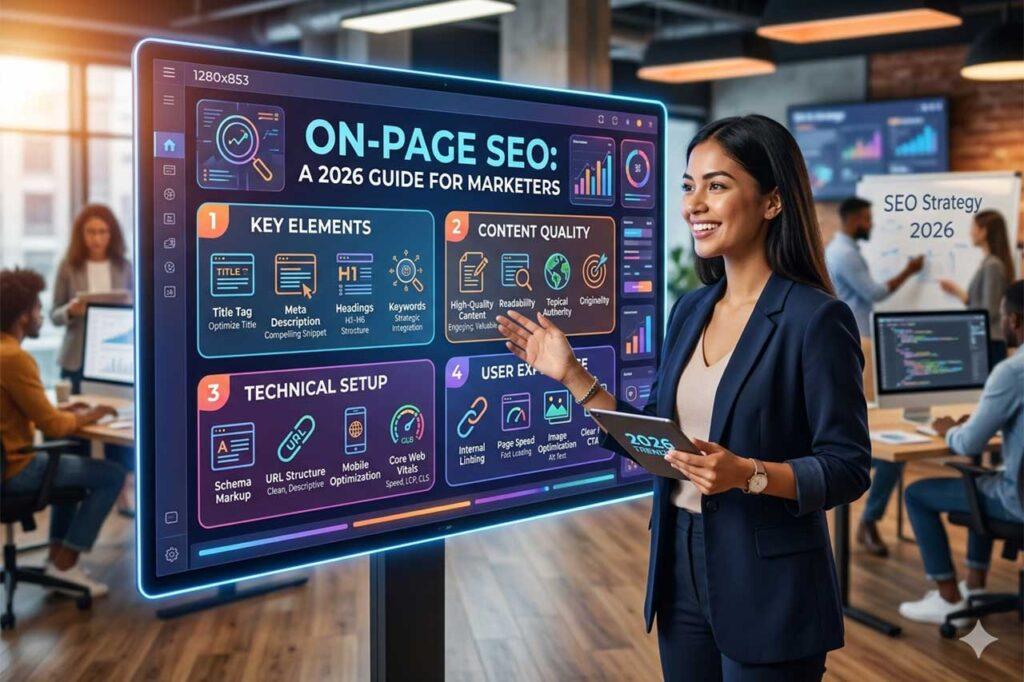
On-page SEO is defined as the practice of optimizing individual webpages, including their content and HTML elements, to improve visibility and rankings in both traditional search engines and AI-powered platforms like Google AI Mode and ChatGPT. Unlike off-page tactics such as link building, on-page SEO sits entirely within your control. Meta descriptions influence CTR 37.22% of the time and directly affect AI citation probability, making every element on your page a lever worth pulling. For digital marketers and website owners in 2026, mastering on-page optimization is the most direct path to organic traffic growth and AI-generated answer visibility.
What is on-page SEO and what does it include?
On-page SEO is the discipline of optimizing the content, structure, and HTML signals on a webpage so that search engines and AI crawlers can understand, rank, and cite it accurately. Search Engine Land defines three core pillars: Relevance (matching search intent), Clarity (logical structure), and Usability (speed and mobile performance). Each pillar maps to specific, actionable elements you can control directly on your site.
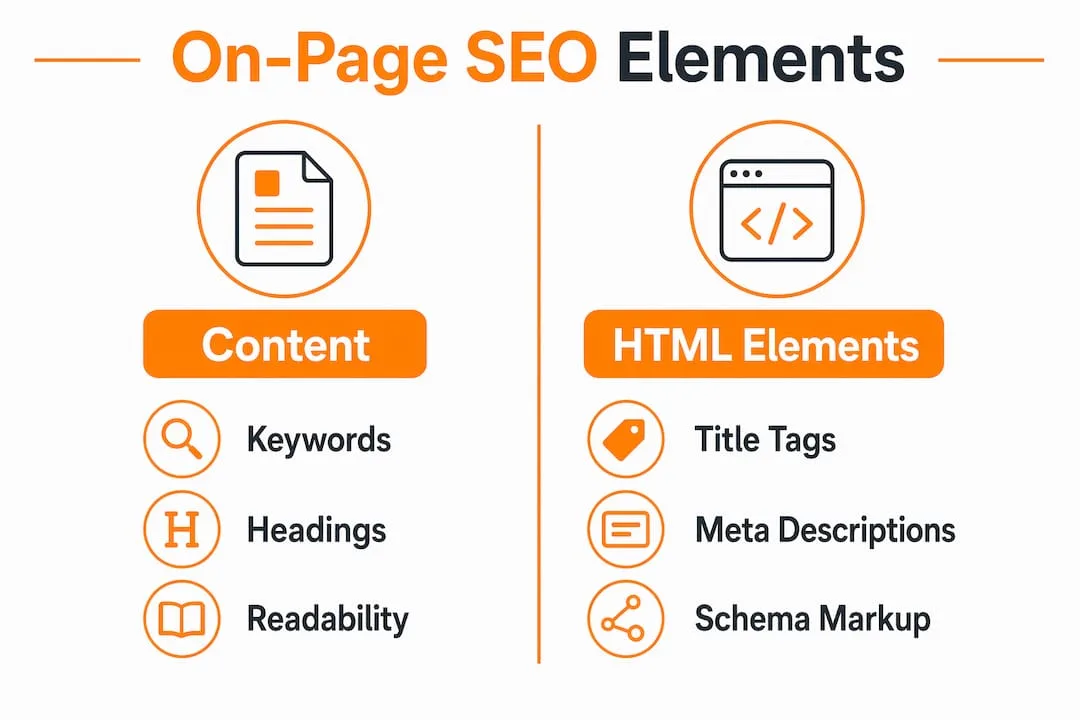
The core components break down into two categories: content signals and technical signals.
Content signals tell search engines what your page is about and whether it satisfies user intent:
- Primary and supporting keywords: Target one primary keyword plus 3 to 5 semantically related terms per page. Ahrefs confirms that topical authority and semantic depth have replaced exact-match keyword repetition as the dominant ranking signal.
- Header hierarchy (H1 through H6): Your H1 should contain the primary keyword. H2s and H3s organize subtopics and signal content depth to crawlers.
- Title tags: These are the clickable headlines in search results. Keep them between 50 and 60 characters to avoid truncation.
- Meta descriptions: Meta descriptions appear as snippets beneath your title in SERPs and directly influence whether a user clicks. The ideal length is 145 to 155 characters.
- Image alt text: Descriptive alt attributes help search engines index images and improve accessibility for screen readers.
Technical signals affect how well your page performs and how easily it can be crawled:
- URL structure: Short, descriptive URLs with the target keyword outperform long, parameter-heavy strings.
- Internal linking: Linking to related content improves crawl efficiency and distributes page authority across your site.
- Page speed and mobile-friendliness: Page speed and accessibility correlate directly with better user metrics and search performance. Google’s Core Web Vitals are the standard benchmark.
Schema markup: Structured data in JSON-LD format helps search engines and AI platforms extract specific facts, ratings, and answers from your content.
Pro Tip: Run your pages through Google Search Console and PageSpeed Insights before making content changes. Technical blockers like slow load times or crawl errors will undermine even the best-written content.
| Element | Optimization target |
|---|---|
| Title tag | 50 to 60 characters, primary keyword near the front |
| Meta description | 145 to 155 characters, clear value proposition |
| Header tags | Logical H1 to H3 hierarchy, keyword-rich but natural |
| Image alt text | Descriptive, 5 to 15 words, includes relevant keyword |
| URL slug | Short, lowercase, hyphen-separated words |
How does on-page SEO differ from off-page and technical SEO?
On-page SEO is the only SEO category where you hold complete control. Off-page SEO covers external signals like backlinks, brand mentions, and social signals. Technical SEO addresses site architecture, crawlability, and server performance. Understanding where each type begins and ends helps you allocate time and budget more effectively.
| SEO type | What it covers | Who controls it |
|---|---|---|
| On-page SEO | Content, HTML elements, internal links, schema | You (site owner) |
| Off-page SEO | Backlinks, brand citations, social signals | Third parties |
| Technical SEO | Site speed, crawl budget, XML sitemaps, HTTPS | Developer or host |
On-page SEO is the first, most manageable optimization any marketer should tackle, because it requires no external cooperation. You write the content, set the title tag, and structure the URL. Off-page SEO, by contrast, depends on other websites choosing to link to you. Technical SEO often requires developer access and can involve complex server configurations.
The practical implication is clear: before investing in a link-building campaign or a site migration, your on-page signals must be solid. A page with a weak title tag, thin content, and no schema markup will not convert backlinks into rankings efficiently. On-page SEO is the foundation that makes every other SEO investment more productive.
Pro Tip: Audit your top 10 traffic pages for on-page signals before launching any off-page campaign. Fixing a misaligned title tag or adding schema markup to an existing page often produces faster ranking gains than acquiring new backlinks.
How to optimize on-page SEO: a step-by-step checklist
Optimizing on-page SEO is a repeatable process, not a one-time task. The 11-step on-page SEO checklist from Similarweb covers every element from keyword research to schema markup. Here is a condensed, prioritized version you can apply to any page:
- Conduct keyword research. Identify one primary keyword and 3 to 5 supporting terms with clear search intent. Use tools like Google Keyword Planner, Ahrefs Keywords Explorer, or Semrush to validate search volume and competition.
- Write a compelling title tag. Place the primary keyword within the first 60 characters. Lead with the keyword when possible. Avoid clickbait that misrepresents the content.
- Craft a meta description between 145 and 155 characters. Include a clear benefit or call to action. This does not directly affect rankings, but it does affect the click-through rate that feeds Google’s behavioral signals.
- Structure your content with a logical header hierarchy. Use one H1 per page. Break the body into H2 sections and H3 subsections. Each heading should reflect a distinct subtopic that a reader would search for independently.
- Create a clean, keyword-rich URL. Remove stop words like “and,” “the,” and “of.” Keep the slug to 3 to 5 words. Example: “/on-page-seo-checklistbeats/blog/post?id=4421`.
- Build internal links to and from the page. Link to at least two related pages on your site. Link from at least two existing pages back to the new one. This distributes authority and improves crawl depth.
- Optimize every image. Compress images using tools like Squoosh or ShortPixel. Write descriptive alt text for each image that includes a relevant keyword where natural.
- Improve page speed. Target a Largest Contentful Paint (LCP) under 2.5 seconds. Defer non-critical JavaScript, enable browser caching, and use a CDN for static assets.
- Add schema markup. Use FAQ schema, Article schema, or HowTo schema depending on content type. JSON-LD is Google’s preferred format and the easiest to implement without touching your HTML.
- Verify mobile-friendliness. Test with Google’s Mobile-Friendly Test tool. Text should be readable without zooming, and tap targets should be at least 48 pixels wide.
- Review and update regularly. On-page SEO must be treated as a continuous optimization cycle, updating keywords, content freshness, and technical factors to maintain visibility.
Pro Tip: Set a quarterly calendar reminder to audit your top 20 pages. Refresh statistics, update internal links to newer content, and re-check title tags against current search volume data. Fresh content signals matter more in 2026 than they did three years ago.
The most common mistake marketers make is treating this checklist as a one-time launch task. Search intent shifts, competitors publish new content, and Google updates its algorithms. A page optimized in 2024 may need significant revision by mid-2026 to hold its position.
How does on-page SEO work for AI search engines in 2026?
On-page SEO now targets two distinct audiences: human readers and AI crawlers. AI systems like ChatGPT parse on-page signals for trustworthiness and extractable answers when generating responses. This means the same structural choices that help Google rank your page also determine whether Perplexity or Google AI Mode cites it.
The shift requires a specific writing approach:
- Answer-first structure: Place the direct answer to the page’s primary question within the first two sentences of the introduction. AI models extract the most prominent, clearly stated claim.
- Clear, machine-readable formatting: Use numbered lists for processes, bullet points for features, and tables for comparisons. Unstructured prose buried in long paragraphs is harder for AI to parse and cite.
- Semantic depth over keyword density: Cover the topic thoroughly by addressing related questions, definitions, and subtopics. Topical authority and semantic relationships signal expertise to both Google’s algorithms and AI language models.
- Schema markup for AI extraction: FAQ schema and HowTo schema give AI platforms pre-formatted question-and-answer pairs to pull directly into generated responses.
- Content freshness: AI platforms favor recently updated content. A page last modified in 2022 competes poorly against a well-structured 2026 update covering the same topic.
“On-page SEO now targets an expanded audience including AI crawlers and assistants, making clear formatting and structured data essential for visibility.” — Similarweb, 2026
The practical result is that on-page SEO and AI content strategy have merged. A page written for human readers with clear structure, direct answers, and schema markup will perform well in both traditional SERPs and AI-generated answer panels. The two goals are no longer separate.
Pro Tip: Test your key pages by pasting the URL into Perplexity and asking it a question your page should answer. If Perplexity does not cite your page, your content structure or answer clarity needs work, not your keyword density.
Key takeaways
On-page SEO is the highest-priority, fully controllable foundation of any search strategy, and in 2026 it must be optimized for both traditional search engines and AI-powered platforms simultaneously.
| Point | Details |
|---|---|
| Definition and scope | On-page SEO covers content, HTML elements, internal links, and schema markup under your direct control. |
| AI visibility is now required | Clear structure and answer-first writing improve citation probability in ChatGPT, Perplexity, and Google AI Mode. |
| On-page before off-page | Fix on-page signals before investing in link building; a weak page wastes every backlink it earns. |
| Continuous optimization | Treat on-page SEO as a quarterly cycle, not a one-time launch task, to maintain rankings as intent shifts. |
| Semantic depth beats keyword stuffing | Topical authority and related subtopics signal expertise more effectively than exact-match keyword repetition. |
Why on-page SEO is where every strategy should start
After working with dozens of businesses on their search visibility, the pattern is consistent: the sites that struggle most are not the ones with too few backlinks. They are the ones with disorganized content, misaligned title tags, and pages that never clearly answer the question they rank for. On-page SEO is the most approachable starting point in all of SEO because you do not need anyone’s permission to fix it.
The advice I give every client before touching their link profile is this: read your own page out loud and ask whether it answers the search query better than the top three results. If the answer is no, no amount of off-page work will close that gap permanently. Google’s algorithms have become sophisticated enough to detect thin, intent-mismatched content even when it carries strong backlink profiles.
The other mistake I see constantly is treating on-page SEO as a technical checklist divorced from content quality. Ahrefs puts it plainly: on-page SEO is only effective when paired with high-quality, intent-matching content. Schema markup on a shallow page is decoration. A well-structured, deeply researched page with clean HTML will outperform a technically perfect shell every time.
My honest recommendation: spend 70% of your initial SEO effort on content quality and on-page structure. The remaining 30% covers technical fixes and link acquisition. That ratio feels counterintuitive to marketers trained to chase backlinks, but it reflects how modern algorithms and AI platforms actually evaluate pages.
Ready to strengthen your on-page SEO?
Knowing the framework is one thing. Executing it consistently across dozens or hundreds of pages is where most teams fall short.
Los Angeles SEO Inc is a top-rated SEO agency based in Los Angeles, delivering on-page SEO audits, content optimization, and full-scale digital marketing solutions to businesses nationwide. Whether you need a complete site audit or targeted page-level optimization, the team at Losangelesseoinc builds strategies grounded in current algorithm signals and AI visibility best practices. If you are ready to turn your website into a consistent source of qualified organic traffic, explore professional SEO services built for measurable results.
FAQ
What is on-page SEO in simple terms?
On-page SEO is the process of optimizing the content and HTML elements of a webpage so that search engines and AI platforms can understand, rank, and cite it. It includes title tags, meta descriptions, header structure, internal links, and schema markup.
What is the difference between on-page and off-page SEO?
On-page SEO covers everything you control directly on your website, including content and HTML signals. Off-page SEO refers to external factors like backlinks and brand mentions that third parties control.
How long should a meta description be for on-page SEO?
Meta descriptions should be 145 to 155 characters to avoid truncation in search results and maximize user interest. Longer descriptions get cut off in SERPs, reducing their effectiveness.
Does on-page SEO affect AI search results?
Yes. AI engines parse on-page signals like content clarity, structure, and schema markup to determine whether to cite a page in generated answers. Answer-first writing and FAQ schema improve citation probability in platforms like ChatGPT and Perplexity.
How often should you update on-page SEO?
On-page SEO requires a continuous optimization cycle, with quarterly reviews recommended. Updating keywords, refreshing statistics, and improving content structure helps pages maintain rankings as search intent and algorithm signals evolve.