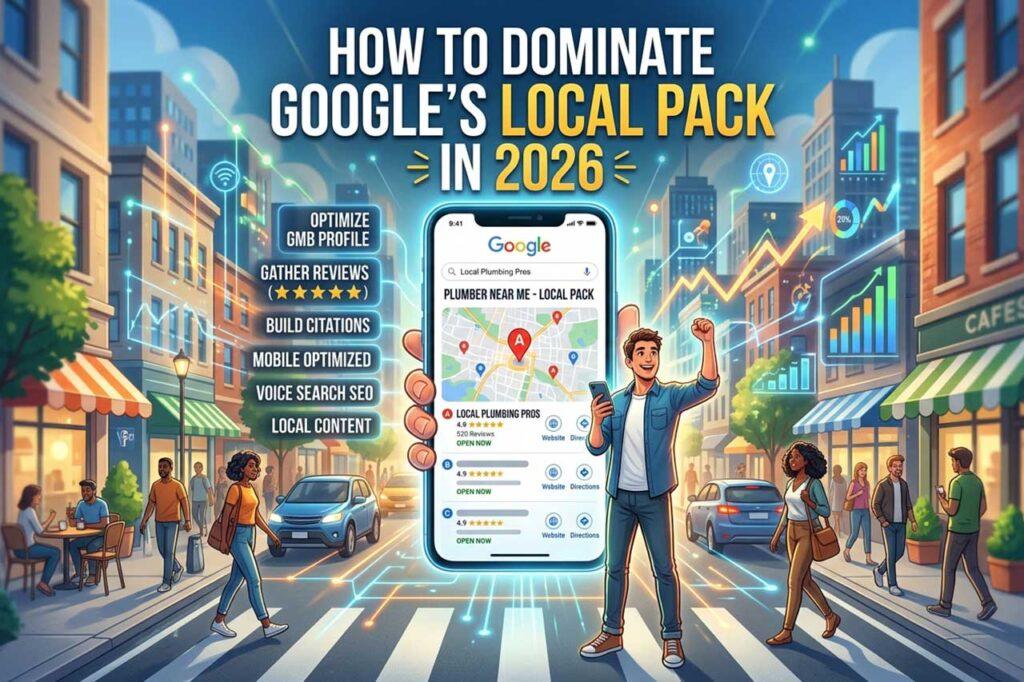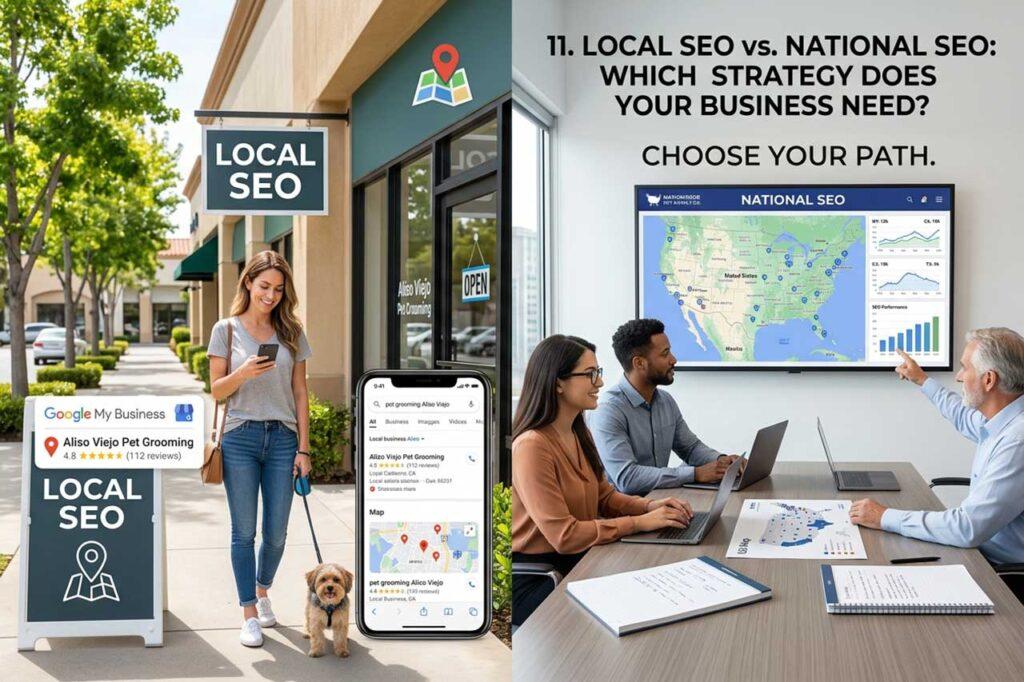
The Local Pack—that coveted block of three business listings that appears at the top of local search results—can make or break your business’s visibility. If you want more foot traffic, phone calls, and customers, ranking here is one of the fastest ways to get there. This guide breaks down exactly how Google decides who earns a spot in the Local Pack, the ranking factors that matter most, and the practical steps you can take to claim your position. By the end, you’ll have a clear action plan to outrank local competitors and turn searches into sales.
Key Takeaways
- The Local Pack shows three business listings with a map, and it appears in roughly 30% of all search results, making it prime real estate for local businesses.
- Google ranks Local Pack listings using three core factors: relevance, distance, and prominence.
- A fully optimized Google Business Profile is the single most important asset for Local Pack success.
- Reviews carry significant weight—both their quantity and quality influence rankings and click-through rates.
- Consistent NAP data (Name, Address, Phone) across the web builds the trust Google needs to rank you confidently.
What is Google's Local Pack?
Google’s Local Pack is the group of three local business listings displayed alongside a map near the top of search results for location-based queries. When someone searches “coffee shop near me” or “plumber in Los Angeles,” Google surfaces the Local Pack to give searchers quick, relevant options tied to their location.
The Local Pack pulls its listings from Google Business Profiles, not standard web pages. Each listing typically shows the business name, star rating, number of reviews, address, hours, and a direct link to call or get directions. According to research from BrightLocal, the Local Pack appears in a large share of local searches and captures a substantial portion of clicks—often before users ever scroll to organic results.
For local businesses, this placement is invaluable. It puts your contact details, reviews, and location front and center at the exact moment a potential customer is ready to act.
How does Google decide who ranks in the Local Pack?
Google ranks Local Pack listings using three primary factors: relevance, distance, and prominence. Understanding each one helps you focus your efforts where they’ll have the biggest impact.
| Ranking Factor | What It Means | How to Improve It |
|---|---|---|
| Relevance | How well your business matches what the searcher is looking for | Complete your Business Profile with accurate categories, services, and descriptions |
| Distance | How close your business is to the searcher or the location they specify | Ensure your address is accurate; target service areas you genuinely serve |
| Prominence | How well-known and trusted your business is online | Build reviews, earn backlinks, and maintain consistent citations |
Distance is largely outside your control, but relevance and prominence are where strategic optimization pays off. The businesses that dominate the Local Pack tend to nail both.
How do you optimize your Google Business Profile for the Local Pack?
Your Google Business Profile (GBP) is the foundation of Local Pack success. A complete, accurate, and active profile signals to Google that your business is legitimate and relevant. Here’s how to optimize it.
Claim and verify your profile
You can’t rank in the Local Pack without a verified Google Business Profile. Head to Google Business Profile Manager, claim your listing, and complete the verification process—usually by postcard, phone, or email.
Fill out every field
Incomplete profiles rarely rank well. Make sure you complete:
- Business name (exactly as it appears in the real world—no keyword stuffing)
- Primary and secondary categories that accurately describe your business
- Full address and service areas
- Phone number and website
- Business hours, including holiday hours
- A detailed business description with relevant keywords used naturally
Add photos and posts regularly
Businesses with photos receive significantly more requests for directions and website clicks than those without. Upload high-quality images of your storefront, team, products, and completed work. Use Google Posts to share updates, offers, and events—these signal that your business is active.
Choose the right categories
Your primary category is one of the strongest relevance signals Google uses. Pick the most specific category that describes your core business, then add secondary categories for additional services. A bakery that also serves lunch, for example, might list “Bakery” as primary and “Sandwich Shop” as secondary.
Why do reviews matter so much for Local Pack rankings?
Reviews influence both your Local Pack ranking and whether searchers actually click your listing. Google treats a steady stream of positive, recent reviews as a strong prominence signal, while shoppers use star ratings and review counts to decide which of the three listings to trust.
To build a strong review profile:
- Ask every satisfied customer for a review. The easiest way is to send a direct link to your Google review form via text or email.
- Respond to every review—positive and negative. Thoughtful responses show Google and customers that you’re engaged.
- Keep reviews flowing consistently. A business that earns a few reviews every week looks healthier than one that got 50 reviews two years ago and nothing since.
- Never buy fake reviews. Google actively detects and penalizes fraudulent reviews, and the risk far outweighs any short-term gain.
For a deeper look at building trust signals across your entire site, explore how Google’s E-E-A-T principles tie into local search performance.
How important is NAP consistency for local rankings?
NAP consistency—matching your Name, Address, and Phone number exactly across every online mention—is critical for Local Pack rankings. When Google finds conflicting information (say, an old address on Yelp and a new one on your website), it loses confidence in your data and may rank you lower.
To keep your NAP clean:
- Audit your listings on major directories like Yelp, Bing Places, Apple Maps, and industry-specific sites.
- Fix or remove duplicate listings that can confuse Google.
- Use the identical format everywhere. “Suite 200” and “Ste. 200” should be standardized to one version.
Citation-building tools and services can automate much of this work, but even a manual audit of your top 10–15 listings makes a meaningful difference.
What role does your website play in Local Pack rankings?
Your website supports your Local Pack performance by reinforcing relevance and prominence signals that Google connects back to your Business Profile. While the Local Pack pulls from GBP, a strong local website amplifies your overall authority.
Build location-specific pages
If you serve multiple areas, create dedicated pages for each location or service area. Each page should include locally relevant content, embedded maps, and consistent NAP details—not thin, duplicated copy.
Add local schema markup
Structured data (LocalBusiness schema) helps search engines understand your business details, including your address, hours, and service area. This makes it easier for Google to associate your website with your Business Profile.
Optimize for mobile and speed
Most local searches happen on mobile devices, and Google prioritizes fast, mobile-friendly experiences. A slow or clunky site can undercut all your other efforts. For a complete audit framework, review the ultimate technical SEO checklist to make sure your site meets today’s standards.
How do backlinks and citations boost Local Pack prominence?
Backlinks and local citations build the prominence Google looks for when ranking Local Pack listings. Each quality mention of your business—whether a link from a local news site or a listing in a trusted directory—reinforces your authority.
Focus on:
- Local backlinks from chambers of commerce, local blogs, sponsorships, and community organizations.
- Structured citations on reputable directories with consistent NAP data.
- Industry-relevant links that connect your business to your niche.
To learn how to earn links that actually move the needle, read our guide on how to earn high-quality backlinks that drive real results. You can also cross-reference Google’s own Business Profile guidelines to stay compliant with its policies.
Common mistakes that keep businesses out of the Local Pack
Even well-run businesses stumble on avoidable errors. Watch out for these:
- Keyword-stuffing your business name. Adding “Best Cheap Plumber LA” to your legal name violates Google’s guidelines and risks suspension.
- Choosing the wrong primary category. A vague or inaccurate category weakens your relevance signal.
- Ignoring reviews. Silence on reviews—especially negative ones—hurts trust.
- Letting your profile go stale. No new photos, posts, or updates tells Google your business may be inactive.
- Inconsistent NAP data. Conflicting details across the web erode Google’s confidence in your listing.
Turn Local Pack visibility into real revenue
Dominating Google’s Local Pack comes down to consistency and completeness: a fully optimized Google Business Profile, a steady stream of genuine reviews, clean NAP data across the web, and a website that reinforces your authority. None of these tactics require a massive budget—just a disciplined, ongoing commitment.
Start by auditing your Google Business Profile today. Fill in every gap, request reviews from your happiest customers, and clean up any inconsistent listings. As those signals strengthen, your position in the Local Pack will follow.
If you’d rather have a proven team handle the heavy lifting, the experts at Los Angeles SEO specialize in local search strategies that help businesses get discovered exactly when customers are searching. Reach out for a free strategy session and start climbing the Local Pack today.
Frequently Asked Questions
How long does it take to rank in Google's Local Pack?
Most businesses see movement within one to three months of consistent optimization, though timelines vary based on competition and your starting point. Highly competitive markets like Los Angeles can take longer, while less saturated niches may see faster results. Ongoing effort—reviews, posts, and citation building—compounds over time.
Is a Google Business Profile free?
Yes. Creating and managing a Google Business Profile is completely free. You only incur costs if you choose to run Google Ads or invest in professional optimization services. The profile itself, including posts, photos, and review management, costs nothing.
Can I rank in the Local Pack without a physical storefront?
Yes. Service-area businesses—like plumbers, electricians, and mobile services—can rank in the Local Pack by setting up a service-area business profile. You’ll specify the regions you serve rather than displaying a storefront address, though a verified location is still required.
How many reviews do I need to rank in the Local Pack?
There’s no magic number, but more high-quality, recent reviews generally improve your chances. What matters most is a steady flow of authentic reviews and active responses rather than hitting a specific count. A consistent trickle beats a one-time flood.
Does the Local Pack ranking differ from organic search ranking?
Yes. The Local Pack is powered by your Google Business Profile and weighs relevance, distance, and prominence, while organic rankings are driven by traditional on-page and off-page SEO. Strong performance in one often supports the other, but they use different signals and appear in different spots on the results page.