
An LA e-commerce SEO strategy is the systematic optimization of your online store’s architecture, content, and technical elements to maximize organic search visibility and conversions in the Los Angeles market. Approximately 75% of users never scroll past the first page of search results. That single fact defines the stakes. For LA-based online stores competing in one of the most crowded retail markets in the country, ranking on page one is not a bonus. It is the baseline. This guide covers keyword research, site architecture, product page optimization, automation workflows, and the most common technical mistakes that cost stores real revenue.
How to align keyword research with buyer intent for LA e-commerce
Keyword research for an LA e-commerce SEO strategy starts with buyer intent, not search volume. A shopper typing “buy women’s streetwear Los Angeles” is ready to purchase. A shopper typing “streetwear trends” is browsing. Targeting both with the same page is a mistake most stores make and never diagnose.
Segment your keywords into three intent tiers:
- Transactional: “buy,” “order,” “shop,” “free shipping LA” — these belong on product and category pages
- Informational: “how to style,” “best options for,” “guide to” — these belong in blog content and buying guides
- Navigational: brand names and specific product model searches — these require optimized brand pages and structured data
Long-tail keywords are the highest-leverage opportunity for LA stores. Phrases like “organic skincare delivery Los Angeles” or “custom furniture store LA” carry lower competition and higher purchase intent. Category pages built on buyer intent and strong internal linking drive long-term SEO growth. That means your category page for “men’s sneakers” should target “men’s sneakers Los Angeles” with a supporting cluster of product pages underneath it.
For scalability, apply a national e-commerce SEO workflow and layer in local modifiers. Tools like Google Search Console, Ahrefs, and Semrush all surface location-filtered keyword data. Use Google Search Console’s Performance report to find queries where you already rank on page two. Those are your fastest wins.

<strong>Pro Tip:</strong> <em>Filter your Ahrefs or Semrush keyword reports by “Los Angeles” as a location modifier. You will find dozens of high-intent, low-competition queries your competitors have ignored.</em>
<a href=”https://betterblogai.com/use-cases/seo-content-workflow-for-ecommerce-brands”>Consumer-facing content</a> like buying guides and product comparisons organized by buyer stage improves conversion quality by reducing ambiguity. Build a content cluster for each major product category and link every piece back to the category page.
What site architecture does for your LA online store's SEO
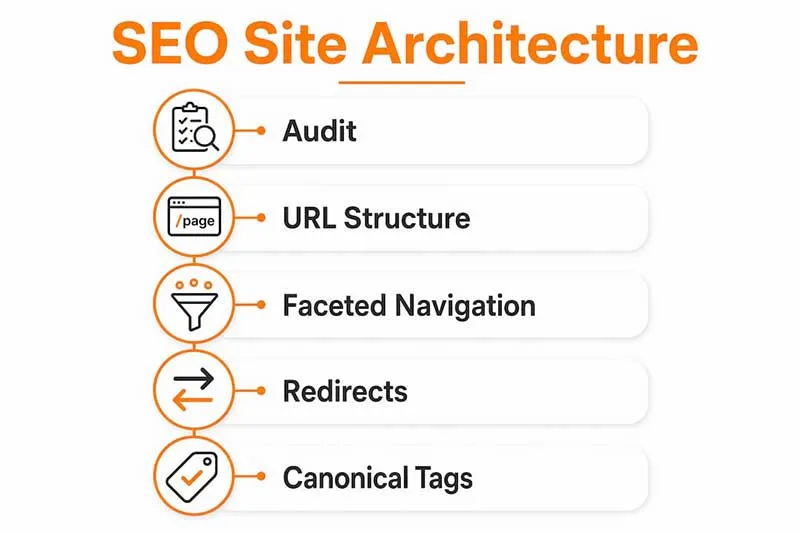
Site architecture is the foundation every other SEO effort depends on. A poorly structured store confuses both users and search engine crawlers. The correct hierarchy is straightforward: Home, then Categories, then Subcategories, then Product pages. Every page should be reachable within three clicks from the homepage.
Follow these steps to build a crawl-efficient structure:
- Map your category hierarchy before building or rebuilding. Sketch every category and subcategory on paper or in a spreadsheet first.
- Create clean, keyword-rich URLs. Use formats like /womens-shoes/running/nike-air-max rather than /product?id=4892. Include location modifiers where natural, such as /la-custom-furniture.
- Implement breadcrumb navigation with Schema.org BreadcrumbList markup. Breadcrumbs reduce bounce rates and give Google clear signals about page hierarchy.
- Apply canonical tags to faceted navigation pages. Filter pages generated by size, color, or price create duplicate content at scale. Canonical tags and robots.txt control which faceted navigation pages get indexed.
- Block non-essential parameter URLs in robots.txt. Session IDs, tracking parameters, and sort-order variations should never consume your crawl budget.
| Architecture Element | Best Practice | Common Mistake |
|---|---|---|
| URL structure | Short, keyword-rich, human-readable | Dynamic parameters like ?cat=5&sort=price |
| Navigation depth | Max 3 clicks from homepage | Burying products 5-6 levels deep |
| Canonical tags | Point filter pages to parent category | No canonicals on faceted nav pages |
| Internal linking | Link categories from homepage and blog | Orphaned product pages with no inbound links |
| Breadcrumbs | Schema.org markup on every page | Plain text breadcrumbs with no structured data |
Pro Tip: Run a Screaming Frog crawl on your store monthly. Filter for pages with more than 3 redirect hops or zero inbound internal links. Fix those before touching anything else.
Faceted navigation is the leading cause of duplicate content bloat in large e-commerce sites. Canonicalization and noindex rules are critical to avoid wasting crawl budget on pages that will never rank.
How to optimize product and category pages for rankings and sales
Product and category pages are where SEO converts to revenue. Every element on these pages must serve two masters: the search engine crawler and the human buyer.
For product titles, lead with the primary keyword and follow with the most relevant secondary attribute. “Men’s Leather Chelsea Boots Los Angeles” outperforms “Chelsea Boots Men” in both specificity and local relevance. Meta descriptions should include a call to action and a differentiator, such as free shipping or same-day delivery in LA.
Key optimization practices for product and category pages:
- Write unique product descriptions. Manufacturer copy appears on hundreds of sites. Google’s systems recognize it. Write descriptions that address the buyer’s specific use case, not just the product’s specs.
- Implement Product and Offer structured data using Schema.org markup. Include price, availability, and review count. Structured data must synchronize with real-time inventory and pricing. A schema tag showing “InStock” when the product is sold out triggers trust penalties and removes you from Google Shopping features.
- Add user-generated reviews to every product page. Reviews provide fresh content signals, increase keyword diversity naturally, and improve conversion rates.
- Use high-quality original images with descriptive alt text. “red-leather-handbag-los-angeles.jpg” performs better than “IMG_4892.jpg” in Google Image Search.
| Architecture Element | Best Practice | Common Mistake |
|---|---|---|
| URL structure | Short, keyword-rich, human-readable | Dynamic parameters like ?cat=5&sort=price |
| Navigation depth | Max 3 clicks from homepage | Burying products 5-6 levels deep |
| Canonical tags | Point filter pages to parent category | No canonicals on faceted nav pages |
| Internal linking | Link categories from homepage and blog | Orphaned product pages with no inbound links |
| Breadcrumbs | Schema.org markup on every page | Plain text breadcrumbs with no structured data |
Integrated SEO workflows that combine buyer intent, site architecture, editorial quality, and optimization loops produce stronger organic growth. Apply that principle to every product page update you make.
How automation scales your LA e-commerce SEO without breaking it
Managing thousands of SKUs manually is not sustainable. Automation handles the volume. Human review maintains the quality. The best LA e-commerce SEO operations run both in parallel.
Core automation workflows every LA store should implement:
- Ranking drop alerts: Set up automated alerts in Google Search Console or a tool like Semrush to notify you when a tracked keyword falls out of the top 10. Automated SEO workflows must include monitoring alerts for ranking drops and competitor price undercuts greater than 15%.
- Inventory and schema sync: Connect your product feed to your structured data layer so schema updates automatically when stock levels or prices change. This prevents the trust penalties described in the product page section above.
- Bulk meta tag generation: Use templated rules to generate title tags and meta descriptions for large product catalogs. A rule like [Product Name] | [Category] | Free Shipping in LA scales across thousands of pages instantly.
- Competitor monitoring: Tools like Semrush’s Position Tracking and Price2Spy track competitor rankings and pricing in real time. When a competitor undercuts your price by more than 15%, your automation should flag it for review.
- Crawl scheduling: Schedule monthly Screaming Frog or Sitebulb crawls to catch new broken links, redirect chains, or orphaned pages before they compound.
Pro Tip: Do not automate your product descriptions. Templated descriptions save time but create thin content at scale. Reserve automation for metadata and technical elements. Write descriptions manually or with human-reviewed AI output.
Automation is a force multiplier, not a replacement for strategy. Every automated rule you set should be audited quarterly to confirm it still reflects your current catalog structure and business priorities.
What are the most common SEO pitfalls for LA e-commerce sites?
Most LA e-commerce stores lose organic traffic to the same five mistakes. Recognizing them early saves significant recovery time.
- Duplicate content from faceted navigation. Uncontrolled filter pages generate hundreds of near-identical URLs. Use canonical tags pointing to parent categories and block parameter-based URLs in robots.txt.
- Slow page speed on mobile. Page speed and mobile optimization directly impact rankings and revenue. Use Google PageSpeed Insights to identify Core Web Vitals failures. Compress images, defer non-critical JavaScript, and use a content delivery network.
- Schema data mismatches. Structured data that conflicts with visible page content triggers manual actions from Google. Audit your schema quarterly using Google’s Rich Results Test.
- Thin category pages. A category page with only a grid of product thumbnails and no descriptive text provides no ranking signal. Add 150–300 words of keyword-rich copy above or below the product grid.
- Ignoring internal link equity. New product pages with no internal links from existing pages are effectively invisible to crawlers. Add links from related category pages and blog posts on launch day.
“SEO for e-commerce in 2026 requires that stores be understandable, crawlable, indexable, and trusted across traditional and AI-powered search features.” — Neotype.ai
Continuous improvement involving site architecture refinement, Core Web Vitals monitoring, and authoritative content development leads to durable visibility and higher conversions over time. Build a monthly audit checklist and stick to it.
Key takeaways
A well-executed LA e-commerce SEO strategy requires buyer-intent keyword targeting, crawl-efficient site architecture, synchronized structured data, and automated monitoring to sustain rankings in a competitive market.
| Point | Details |
|---|---|
| Buyer intent drives keyword selection | Segment keywords by transactional, informational, and navigational intent before assigning them to pages. |
| Site architecture determines crawlability | Keep all product pages within three clicks of the homepage and apply canonical tags to faceted navigation. |
| Structured data must stay synchronized | Schema markup showing incorrect stock or pricing triggers Google trust penalties and removes Shopping eligibility. |
| Automation scales volume, not quality | Automate metadata and alerts; write product descriptions manually or with human review to avoid thin content. |
| Monthly audits prevent compounding errors | Use Screaming Frog or Sitebulb monthly to catch broken links, orphaned pages, and Core Web Vitals failures early. |
What i have learned after years of LA e-commerce SEO work
The biggest mistake I see LA e-commerce owners make is treating SEO as a one-time project. They invest in a site audit, fix the issues, and then go quiet for six months. By then, algorithm updates have shifted, competitors have moved, and the gains are gone.
The LA market is particularly unforgiving. You are competing with national retailers, direct-to-consumer brands with deep pockets, and local boutiques that have been building domain authority for a decade. The stores that win consistently are the ones that treat SEO as an ongoing operational function, not a marketing campaign.
I have also seen stores over-automate to the point where their product descriptions become indistinguishable from one another. Automation handles scale. Human judgment handles quality. You need both. The digital marketing strategies that work for California businesses consistently combine technical precision with content that actually speaks to local buyers.
My honest recommendation: build your monthly audit checklist before you build anything else. Know your baseline. Track your Core Web Vitals, your top 20 ranking keywords, and your schema error count every single month. The stores that monitor consistently are the ones that catch problems before they become revenue losses.
— Sasan Raeisi
How los angeles SEO inc can build your e-commerce SEO foundation
If you are ready to move from theory to execution, Los Angeles SEO Inc builds and manages complete E-Commerce SEO strategies for LA-based e-commerce businesses.
Los Angeles SEO Inc specializes in technical SEO audits, product page optimization, structured data implementation, and automation workflow setup tailored specifically for online stores. Whether you are launching a new store or recovering lost rankings, the team brings the same methodology used in this guide to your specific catalog and market. As a top-rated LA SEO agency, Los Angeles SEO Inc combines local market knowledge with a proven national e-commerce SEO workflow to deliver measurable organic growth. Contact Los Angeles SEO Inc today for a strategy consultation or full site audit.
FAQ
What is an LA e-commerce SEO strategy?
An LA e-commerce SEO strategy is the targeted optimization of an online store’s technical structure, content, and authority signals to rank on the first page of Google for buyer-intent searches in the Los Angeles market. It combines national SEO best practices with local keyword targeting and market-specific competitive analysis.
How do canonical tags fix duplicate content on e-commerce sites?
Canonical tags tell Google which version of a URL is the authoritative one. On e-commerce sites, they point filter and sort pages back to the parent category page, preventing duplicate content penalties from faceted navigation.
Why does structured data matter for e-commerce SEO?
Structured data using Schema.org markup makes your products eligible for Google Shopping features and rich results. When schema data mismatches live inventory or pricing, Google can remove those enhancements and apply trust penalties.
How often should i audit my e-commerce site for SEO issues?
Run a full technical crawl using Screaming Frog or Sitebulb every month. Check Google Search Console weekly for crawl errors, manual actions, and Core Web Vitals failures. Quarterly, audit your schema markup with Google’s Rich Results Test.
What is the fastest way to improve e-commerce SEO rankings?
The fastest wins come from targeting keywords where you already rank on page two of Google. Use Google Search Console’s Performance report to find those queries, then improve the matching page’s title tag, internal links, and content depth.