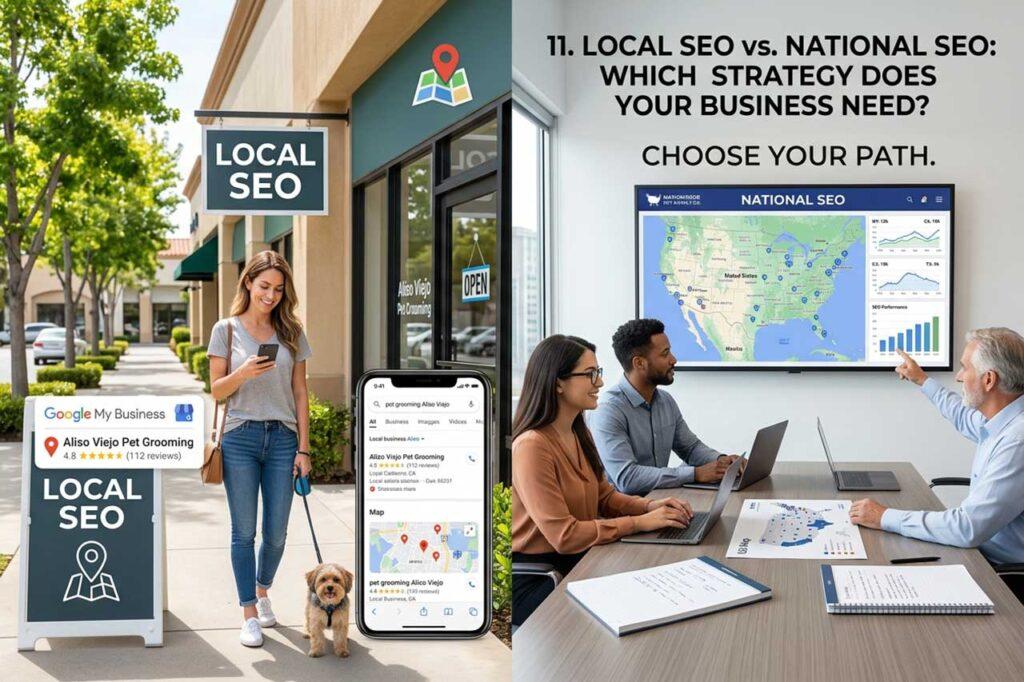
Choosing between local SEO and national SEO is one of the most consequential decisions a business can make about its digital marketing strategy—and the wrong choice can waste months of effort and thousands of dollars. Local SEO targets customers in a specific geographic area, while national SEO competes for visibility across an entire country. The right approach depends on your business model, customer base, and growth goals. This guide breaks down how each strategy works, where they differ, and how to determine which one belongs in your marketing plan.
Key Takeaways
- Local SEO is designed to attract customers in a specific city, region, or neighborhood—ideal for brick-and-mortar businesses and service-area companies.
- National SEO targets broad, high-volume keywords across the entire country and suits businesses that sell online or serve customers regardless of location.
- The two strategies are not mutually exclusive—many growing businesses benefit from a hybrid approach.
- Google Business Profile optimization, local citations, and geo-targeted content are the cornerstones of local SEO.
- National SEO demands higher domain authority, aggressive link building, and a robust content strategy to compete for competitive keywords.
What Is Local SEO and How Does It Work?
Local SEO is the practice of optimizing your online presence to attract customers in a specific geographic area. When someone searches “best dentist near me” or “plumber in Los Angeles,” Google surfaces results based on the user’s location. Local SEO ensures your business appears in those results—specifically in the Google Local Pack (the map-based results at the top of the page) and in organic search listings for geo-modified queries.
The core components of a local SEO strategy include:
- Google Business Profile (GBP) optimization — Claiming, verifying, and fully optimizing your GBP listing with accurate business information, photos, categories, and consistent review management.
- Local citations — Ensuring your business Name, Address, and Phone number (NAP) are consistent across directories like Yelp, Bing Places, and industry-specific platforms.
- Geo-targeted content — Creating pages and blog posts that reference specific locations, neighborhoods, or service areas.
- Localized link building — Earning backlinks from regional publications, local chambers of commerce, and community organizations.
- Customer reviews — Generating and responding to reviews on Google, Yelp, and other platforms to build trust and improve local rankings.
For a deeper dive into local SEO fundamentals, the Ultimate Guide to Local SEO for Los Angeles Businesses covers everything from citation building to map pack optimization in one comprehensive resource.
What Is National SEO and How Does It Differ?
National SEO focuses on ranking for high-volume, non-location-specific keywords that attract visitors from across the country—or even globally. A SaaS company, an e-commerce retailer, or a media publisher, for example, isn’t concerned with whether a visitor is in Denver or Dallas. Their goal is volume and authority.
National SEO requires:
- High domain authority — Competing for broad keywords means competing against large, established websites. Domain authority—built through years of quality content and backlinks—is critical.
- Aggressive content marketing — National strategies typically demand pillar pages, topic clusters, and a consistent publishing cadence to cover every angle of a subject.
- Scalable link building — Earning backlinks from high-authority national publications, industry blogs, and news sites is essential for national ranking signals. Understanding how to earn high-quality backlinks is one of the most important skills in a national SEO toolkit.
- Technical SEO excellence — Site speed, Core Web Vitals, mobile optimization, and crawlability become increasingly important as competition intensifies at a national level.
- Keyword depth — National strategies target head terms, mid-tail, and long-tail keywords across the full buyer’s journey, requiring extensive keyword research and content planning.
Local SEO vs. National SEO: A Side-by-Side Comparison
The table below highlights the key distinctions between the two strategies across the most important dimensions:
| Factor | Local SEO | National SEO |
|---|---|---|
| Target audience | Customers in a specific city, region, or neighborhood | Customers nationwide, regardless of location |
| Primary keywords | Geo-modified terms (e.g., "electrician in Miami") | Broad, high-volume terms (e.g., "best project management software") |
| Competition level | Moderate — competing against local businesses | High — competing against major national brands |
| Key tactics | GBP optimization, local citations, review management | Link building, content clusters, technical SEO |
| Time to results | Typically 3–6 months | Typically 6–12+ months |
| Typical cost | Lower — more targeted scope | Higher — broader reach requires more resources |
| Best for | Restaurants, law firms, dental practices, service businesses | E-commerce, SaaS, media, national service providers |
| Ranking signals | Proximity, relevance, GBP signals | Domain authority, backlink profile, content quality |
Which Businesses Should Prioritize Local SEO?
Local SEO delivers the strongest ROI for businesses where geography directly influences purchasing decisions. If your customers need to visit a physical location, or if you only serve clients within a defined service area, local SEO should be the foundation of your digital marketing strategy.
Choose local SEO if your business is:
- A restaurant, café, or retail store with a physical location
- A law firm, dental practice, or medical clinic
- A home services company (plumber, electrician, landscaper)
- A real estate agency operating in specific markets
- A local accounting or financial services firm
According to Google, 76% of people who search for something nearby on their smartphone visit a related business within a day, and 28% of those searches result in a purchase. For businesses with a physical presence, intent-driven traffic is invaluable.
Which Businesses Should Prioritize National SEO?
National SEO is the right fit when your product or service isn’t bound by geography. If you sell products online, offer software subscriptions, or provide professional services remotely, your audience exists everywhere—and your SEO strategy should reflect that.
Choose national SEO if your business:
- Operates an e-commerce store that ships nationally
- Offers a SaaS product or digital service
- Publishes content, media, or educational resources
- Provides consulting or freelance services remotely
- Is a franchise or multi-location brand building top-level authority
National SEO rewards patience and investment. The timelines are longer, the competition is fiercer, and the content requirements are more demanding. But when done well, a strong national organic presence can generate scalable traffic without the ongoing cost of paid advertising.
Can You Run Both Local and National SEO Simultaneously?
Yes—and for many businesses, a hybrid approach is the most strategic path forward. A law firm with offices in multiple cities, for example, needs local SEO for each location while simultaneously building national authority to attract high-value clients outside a single market. A multi-location retailer might optimize each store’s Google Business Profile locally while also running national campaigns for brand awareness and e-commerce traffic.
A hybrid SEO strategy typically involves:
- Location-specific landing pages — Unique pages for each city or region, targeting geo-modified keywords while contributing to overall domain authority.
- Centralized content strategy — National-level blog posts, guides, and thought leadership content that drives links and brand recognition.
- Tiered link building — Local backlinks (directories, regional media) support individual location pages, while national backlinks support the root domain.
- Consistent technical foundation — A single, well-optimized website that performs equally well for local and national queries.
The key risk with hybrid strategies is dilution—trying to do everything at once without enough resources to do any of it well. Prioritize based on where your revenue comes from today, then expand.
How to Decide: 4 Questions to Ask Before Choosing a Strategy
If you’re still unsure which SEO approach fits your business, work through these four questions:
- Where do your customers come from? If the vast majority are within 20–30 miles of your business, local SEO is the clear priority.
- Does your business have a physical location customers visit? If yes, local SEO is non-negotiable.
- Do you sell products or services online to customers anywhere in the country? National SEO should be central to your strategy.
- Do you have the budget and timeline for a long-term national campaign? National SEO requires sustained investment. If resources are limited, local SEO often delivers faster, more measurable returns.
According to BrightLocal’s Local Consumer Review Survey, 98% of consumers used the internet to find information about local businesses in 2022, reinforcing that even businesses focused on local customers need a strong digital presence to compete.
The Right SEO Strategy Starts with the Right Partner
Local SEO vs. national SEO isn’t a debate with a universal answer—it’s a strategic decision shaped by your business model, market position, and growth objectives. Both approaches require technical expertise, consistent execution, and a clear understanding of how your customers search online.
Los Angeles SEO Inc. has spent over 13 years helping businesses across every industry find and implement the SEO strategy that drives real revenue. Whether you need to dominate your local market, build national authority, or pursue both at once, our team builds data-backed strategies tailored to your specific goals. Get your free strategy session today and find out which SEO approach is right for your business.
Frequently Asked Questions
What is the main difference between local SEO and national SEO?
Local SEO targets customers in a specific geographic area—like a city or neighborhood—using tactics like Google Business Profile optimization, local citations, and geo-modified keywords. National SEO targets broad, non-location-specific keywords to attract visitors from across the country. The primary difference lies in the audience’s location, the competition level, and the tactics required to rank.
How long does it take to see results from local SEO vs. national SEO?
Local SEO typically produces measurable results within 3–6 months, depending on competition in your market. National SEO generally takes 6–12 months or longer, because ranking for high-volume national keywords requires greater domain authority, a deeper content library, and a stronger backlink profile.
Is local SEO cheaper than national SEO?
Yes, in most cases. Local SEO has a more defined scope—you’re competing against other local businesses rather than national brands with large marketing budgets. National SEO requires more content production, more aggressive link building, and longer timelines, all of which increase cost. However, both strategies require consistent investment to maintain and improve rankings.
Can a small business benefit from national SEO?
A small business can benefit from national SEO if it sells products or services that don’t require physical proximity to customers—such as online retail, digital services, or niche products with nationwide demand. However, small businesses with limited resources often find local SEO delivers a stronger and faster return on investment.
What happens if I target national keywords but only serve a local area?
Targeting national keywords as a local business wastes your SEO budget and effort. You’ll compete against large, established websites with far greater authority, making it nearly impossible to rank. Worse, the traffic you do attract may not convert, since those visitors aren’t in your service area. Focus on geo-targeted keywords that match your actual customer base.
Does Google Business Profile matter for national SEO?
Google Business Profile is primarily a local SEO tool—it influences rankings in the Google Local Pack for location-based searches. It has little direct impact on national organic rankings. Businesses running national SEO strategies should still maintain an accurate GBP listing, but it won’t be a significant ranking driver for broad, non-local keywords.