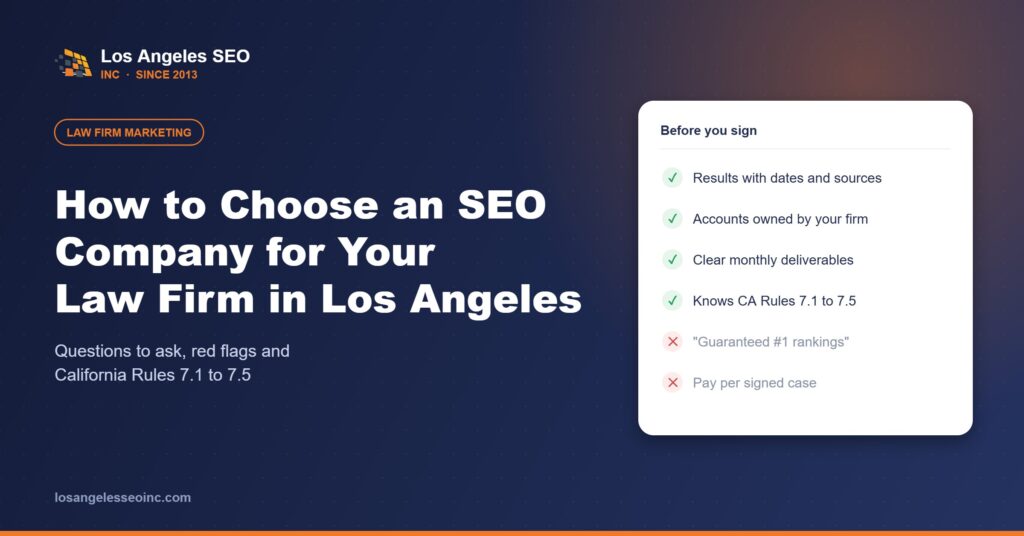
To choose an SEO company for your law firm in Los Angeles, pick one that can show real results it produced for firms like yours, explains exactly what it will do each month, keeps every account in your firm’s name, and understands the California advertising rules your marketing must follow. Everything else is secondary.
Legal is one of the most expensive markets online, so a bad hire costs real money. Below are the questions we would ask if we were in your seat, the red flags that should end the conversation, and the State Bar rules any agency writing your content needs to know.
Key Takeaways
- Ask for results with dates and a source you can check, not just testimonials.
- Your website, Google Business Profile, Analytics and Ads accounts should always be owned by your firm.
- Anyone who guarantees a #1 ranking is a red flag. Google says no one can promise that.
- Paying per signed case can conflict with California Rule 7.2. Talk to ethics counsel first.
- Your SEO company should know Rules 7.1 to 7.5 well enough to keep your pages, reviews and ads compliant.
Why the choice matters more for law firms
Search demand for legal help is huge and the clicks are expensive. Google’s Keyword Planner shows about 40,500 searches a month in the US for “lawyer near me,” with an average cost of about $24 per click (October 2026). Agencies feel it too: “law firm seo” averages about 3,600 searches a month, with top-of-page bids between roughly $29 and $85.
When paid clicks cost that much, organic rankings and Google Maps visibility become one of the best investments a firm can make. They also make it tempting for weak agencies to overpromise. That is why the vetting below is worth an hour of your time.
7 questions to ask before you sign
- Who else do you work with in my practice area and city? An agency running SEO for two personal injury firms in the same neighborhood has a conflict. Ask whether they offer exclusivity.
- Can you show results you produced, with dates and a source? Rankings screenshots are easy to fake. Ask to see Search Console or Analytics data for a real client (with permission), and when the work started.
- What exactly happens each month? You should get a plain list: pages written, technical fixes, Google Business Profile work, links earned, and who does each one.
- Who owns the website and the accounts? The domain, website, Google Business Profile, Analytics, Search Console and Ads accounts should be in your firm’s name, with the agency added as a user.
- How will you report results? Look for calls, form leads and consultations tied to search, not just a rankings chart.
- How do you handle California’s lawyer advertising rules? A good answer mentions Rules 7.1 to 7.5 and shows how they review content before it goes live.
- What happens if we part ways? Ask about contract length, notice period, and whether you keep all content, links and accounts.
Red flags that should end the conversation
- Guaranteed rankings. Google’s own guide to hiring an SEO says plainly that no one can guarantee a #1 ranking on Google.
- Pay per signed case or per referral. California Rule 7.2 generally prohibits paying anyone to recommend or secure legal work. Paying the reasonable cost of advertising is allowed; paying a share of fees for cases usually is not.
- Fake or bought reviews. They can violate Rule 7.1 and the FTC’s 2024 rule on fake reviews and testimonials, and Google removes them.
- Cheap link packages. Hundreds of links from unrelated or throwaway sites can trigger a Google spam action and take years to clean up.
- “Specialist” or “expert” claims on your pages. Under Rule 7.4, a lawyer may claim to be a certified specialist only when certified by the State Bar’s Board of Legal Specialization or another accredited body, which must be named.
- The agency owns your domain or Google Business Profile. If they hold the keys, leaving gets expensive.
- The same content on several firms’ sites. Duplicate pages rarely rank, and it means you are paying for a template.
California advertising rules your SEO company should know
| Rule | What it means for your website, profile and ads |
|---|---|
| 7.1 | No false or misleading statements. No guaranteed outcomes. Past results and testimonials need context so readers don’t expect the same result. |
| 7.2 | Every advertisement must include the name and address of at least one responsible lawyer or law firm. Paying for recommendations is generally prohibited, with limited exceptions. |
| 7.3 | No live, real-time solicitation for pay. Targeted written or electronic solicitations must be labeled “Advertisement,” with some exceptions. |
| 7.4 | “Certified specialist” only with a current certification, and the certifying body must be named. |
| 7.5 | Firm names and other professional designations, including logos and URLs, cannot be misleading. |
This is a summary, not legal advice. Read the full text on the State Bar of California’s Chapter 7 page and check with your ethics counsel.
What a good law firm SEO plan includes
- A page for each practice area and case type, written for the questions clients actually ask.
- Location pages only where you serve clients, with real local detail.
- A complete, accurate Google Business Profile and a steady, compliant review process.
- Technical health: fast pages, clean indexing, mobile usability and structured data.
- Links earned from bar associations, community organizations, legal directories and local press.
- Call and form tracking, so you can see which searches turn into consultations.
Practice areas need different plans. A personal injury firm competes on Maps and high-cost case types, an immigration practice often needs multilingual pages, and an employment law firm serves both workers and businesses.
How we work with law firms
Los Angeles SEO Inc has served businesses since 2013, and law firms are one of our core industries. For Shaker Law Group, we built a modern, mobile-friendly website and ran a local SEO campaign that included Google Business Profile optimization and location-based keyword targeting.
Every law firm engagement is quoted after a free review of your site, competitors and goals. See our law firm SEO services, law firm website design and full law firm digital marketing, or request a free assessment.
Frequently asked questions
How do I know if a law firm SEO company is any good?
Ask for results they produced for other firms, with dates and a source you can check, such as Search Console data. A good company explains exactly what it will do each month, reports on calls and form leads, and keeps every account in your firm’s name.
Can an SEO company guarantee my law firm will rank #1?
No. Google itself says no one can guarantee a #1 ranking. A company that promises a specific position is either guessing or planning shortcuts that can hurt your site.
Is it legal to pay an SEO company per signed case in California?
Be careful. California Rule of Professional Conduct 7.2 generally bars paying anyone to recommend or secure legal work, with limited exceptions such as the reasonable cost of advertising and certified lawyer referral services. Ask your ethics counsel before agreeing to pay per case.
How much does law firm SEO cost in Los Angeles?
It depends on your practice area, market and goals, so reputable companies quote after reviewing your site and competition. Personal injury in Los Angeles costs far more to compete in than a niche practice in a smaller city.
Sources: State Bar of California, Rules of Professional Conduct, Chapter 7; Google Search Central, “Do you need an SEO?”; Google Ads Keyword Planner, US data, October 2026.