Most websites convert less than 5% of first-time visitors—meaning 95% of the people who find your site leave without taking action. Remarketing changes that equation. By targeting users who’ve already shown interest in your brand, remarketing campaigns consistently deliver higher click-through rates, lower cost-per-acquisition, and stronger ROI than cold-audience advertising. This guide breaks down the most effective remarketing strategies, how to implement them, and how to choose the right approach for your business goals.
Key Takeaways
- Remarketing targets users who previously visited your site, making them significantly more likely to convert than cold audiences.
- Segmenting audiences by behavior—such as cart abandoners vs. blog readers—produces stronger results than broad retargeting.
- Google Display Network, Meta Ads, and email remarketing are the three core remarketing channels worth mastering first.
- Dynamic remarketing, which automatically shows users the exact products or pages they viewed, consistently outperforms static ad campaigns.
- Frequency capping is essential—over-retargeting damages brand perception and increases ad fatigue.
What Is Remarketing, and Why Does It Work?
Remarketing (also called retargeting) is a digital advertising technique that serves ads to users who have previously interacted with your website, app, or content. When a user visits your site, a small piece of code—called a pixel—drops a cookie in their browser. Advertisers then use that data to follow the user across the web with relevant ads.
The reason retargeting outperforms most other paid strategies comes down to intent. A user who visited your pricing page already understands your product. Serving them a tailored offer doesn’t feel intrusive—it feels timely. According to WordStream, remarketing ads can produce click-through rates up to 10x higher than standard display ads.
How to Segment Your Remarketing Audiences Effectively
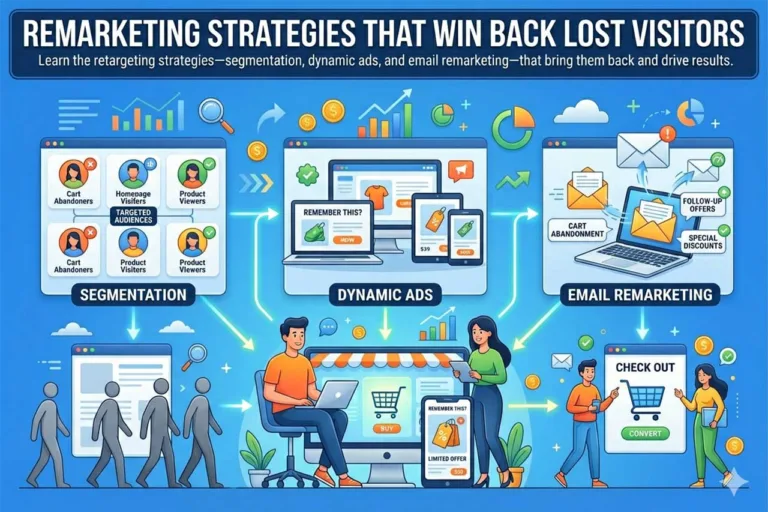
Generic remarketing—showing the same ad to everyone who ever visited your homepage—is one of the most common mistakes advertisers make. Audience segmentation is where the real performance gains are found.
Segment by Page Type
Different pages signal different levels of intent. Group your audiences accordingly:
- Homepage visitors: Low intent; best suited for brand awareness campaigns
- Product or service page visitors: Medium-high intent; ready for a direct offer or comparison content
- Pricing page visitors: High intent; prioritize testimonials, guarantees, and limited-time incentives
- Cart or checkout abandoners: Highest intent; focus on urgency, social proof, and friction reduction
Segment by Time Window
Recency matters. A visitor who left your site 2 hours ago is far more valuable than one who left 60 days ago. Most platforms let you create audience windows of 7, 14, 30, or 90 days. Shorter windows should carry more aggressive offers; longer windows can focus on re-education and brand reinforcement.
Exclude Converted Users
Always exclude users who have already completed a purchase or lead form. Continuing to show acquisition ads to existing customers wastes budget and creates a poor post-purchase experience.
For a deeper look at how audience segmentation connects to your broader paid strategy, see our guide on PPC campaign management in Los Angeles.
The Three Core Remarketing Channels
Google Display Network Remarketing
Google’s Display Network reaches over 90% of internet users globally, making it the most scalable retargeting channel available. After installing the Google Ads tag on your site, you can create audience lists directly within Google Ads and serve banner, responsive, and video ads across millions of partner websites.
Best for: B2C brands with visual products, local service businesses, and e-commerce sites with clear product categories.
Meta (Facebook and Instagram) Remarketing
Meta’s Pixel enables granular behavioral tracking—viewing content, adding to cart, initiating checkout, and purchasing—allowing advertisers to build highly specific audience segments. Meta retargeting performs especially well for visually driven brands and businesses with longer consideration cycles.
Best for: Direct-to-consumer brands, course creators, and service businesses where trust and social proof drive conversions.
Email Remarketing
If a visitor has previously provided their email address, behavioral email sequences are among the most cost-effective retargeting tools available. Triggered emails—sent when a user abandons a cart, views a page multiple times, or hasn’t engaged in 30 days—achieve open rates significantly higher than standard broadcast campaigns, according to Klaviyo’s 2023 benchmark data.
Best for: E-commerce, SaaS, and any business with an established email list.
Dynamic Retargeting: Showing Users Exactly What They Viewed
Dynamic retargeting automatically generates personalized ads based on the specific pages or products a user viewed. Rather than showing a generic “Come back!” banner, a dynamic ad might display the exact pair of running shoes a visitor browsed, along with the current price.
Google Shopping campaigns and Meta’s Advantage+ Catalog Ads both natively support dynamic remarketing. To implement it, you’ll need:
- A product or content feed uploaded to your ad platform
- A properly configured pixel or tag that captures product IDs
- A responsive ad template that pulls in feed data automatically
The performance advantage is significant. Dynamic campaigns typically achieve 2x to 3x higher conversion rates than static remarketing, according to Google’s internal data.
What Frequency Cap Should You Set for Retargeting Ads?
Frequency capping limits how many times a single user sees your ad within a given time period. Without it, retargeting quickly shifts from helpful to intrusive—and once a user finds your ads annoying, the brand damage is difficult to reverse.
A common starting benchmark is 5–7 impressions per user per week on display networks. On social platforms like Meta, monitor your ad frequency metric closely; anything above 3–4 per week for the same creative typically signals diminishing returns and the need for a creative refresh.
Rotating 3–4 ad variations simultaneously also reduces fatigue while maintaining consistent reach.
How Does Remarketing Fit Into a Local SEO Strategy?
For businesses targeting local markets, remarketing and SEO work together more closely than most people realize. Organic search drives initial awareness—someone searches “Los Angeles SEO agency” and lands on your site. Remarketing closes the gap between that first visit and the conversion.
Running geo-targeted remarketing campaigns ensures your budget is focused on users in your actual service area. Combined with strong local landing pages and consistent Google Business Profile optimization, remarketing creates a full-funnel local marketing system that compounds over time.
For additional context on how paid and organic strategies interact, Google’s own Ads Help Center on remarketing is a reliable technical reference.
Remarketing Best Practices: A Quick Reference
| Practice | Why It Matters |
|---|---|
| Segment audiences by intent level | Higher relevance = higher conversion rates |
| Exclude recent converters | Prevents wasted spend and negative UX |
| Set frequency caps | Reduces ad fatigue and brand damage |
| Rotate creative regularly | Maintains engagement, combats banner blindness |
| Use dynamic ads where possible | Personalization consistently lifts CTR and CVR |
| Align ad copy with page visited | Message match improves click quality |
| Test landing pages, not just ads | The destination matters as much as the click |
Ready to Build a Remarketing Strategy That Actually Converts?
Remarketing is one of the highest-leverage tactics in digital marketing—but only when it’s built on clean segmentation, relevant creative, and thoughtful frequency management. Start by installing your pixels correctly, defining your audience tiers by intent level, and prioritizing dynamic ads wherever your platform supports them.
The businesses seeing the strongest results aren’t just retargeting everyone who visited. They’re building retargeting systems that mirror the buyer journey—meeting users with the right message at exactly the right moment.
If you’re ready to implement a remarketing strategy alongside a broader SEO and paid search approach, explore how Los Angeles SEO Inc. helps local businesses build integrated digital marketing campaigns.
Frequently Asked Questions
What is the difference between remarketing and retargeting?
The terms are often used interchangeably. Technically, “retargeting” typically refers to cookie-based display advertising, while “remarketing” originally referred to re-engagement via email. Today, Google uses “remarketing” to describe both, and most marketers treat the two terms as synonymous.
How much budget do I need to run effective remarketing campaigns?
Retargeting audiences are smaller than cold audiences, so budgets can be modest. Many small businesses run effective retargeting campaigns for $500–$1,000 per month. The key is ensuring your audience lists are large enough—Google recommends at least 1,000 active users per list before ads serve at a meaningful volume.
How long should I remarket to a visitor before stopping?
Most conversion windows close within 30 days of a site visit. A 30-day audience window is a solid default for most businesses. For high-consideration purchases (real estate, B2B services, enterprise software), extending the payment term to 60 or 90 days is reasonable.
Is remarketing effective for B2B businesses?
Yes, particularly on LinkedIn, which allows retargeting users by job title, company size, and industry. B2B sales cycles are longer, making the nurturing function of these campaigns especially valuable for keeping your brand visible between touchpoints.
Does remarketing affect SEO?
Remarketing does not directly influence organic search rankings. However, it indirectly supports SEO by increasing return visits, reducing overall bounce rates, and improving conversion rates on pages that already receive organic traffic.