
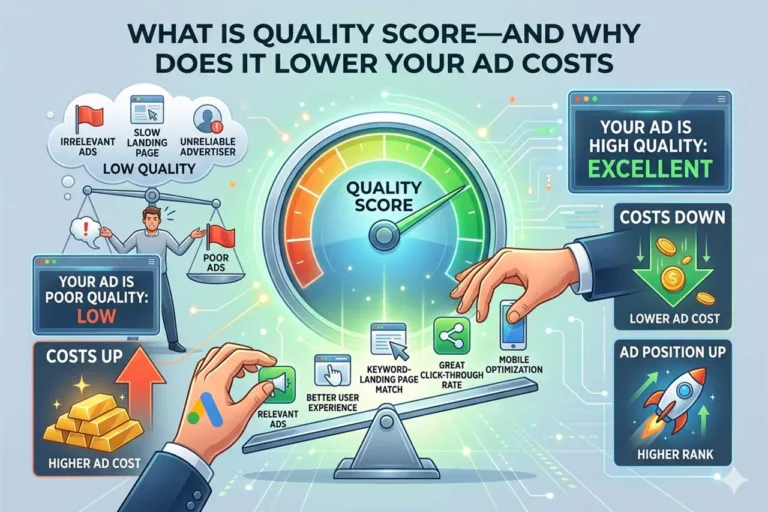
Google Ads can drain your budget fast—unless you understand the mechanics working behind the scenes. Quality Score is one of the most influential (and most misunderstood) factors in Google Ads, directly affecting how much you pay per click and where your ads appear. This guide breaks down exactly what this metric is, how it’s calculated, why it matters for your ad spend, and the practical steps you can take to improve it.
Key Takeaways
- Quality Score is Google’s 1–10 rating of your ad’s relevance and user experience, and a higher score means lower cost-per-click (CPC).
- Quality Score is determined by three components: expected click-through rate (CTR), ad relevance, and landing page experience.
- A high Quality Score can reduce your CPC by up to 50%, while a low score can increase it by up to 400%.
- Improving ad copy alignment, keyword grouping, and landing page quality are the most effective ways to raise your score.
- Quality Score is a diagnostic tool—use it to identify weak points in your campaigns, not just as a vanity metric.
What Is Quality Score in Google Ads?
Quality Score is a diagnostic metric Google uses to evaluate the overall quality and relevance of your ads, keywords, and landing pages. Scored on a scale of 1 to 10 (with 10 being the best), it’s assigned at the keyword level and reflects how well your ad experience matches what a user is actually searching for.
Google introduced this rating system to improve the search experience. The logic is straightforward: advertisers who deliver relevant, useful ads are rewarded with lower costs and better placements. Those who don’t are penalized.
How Is Quality Score Calculated?
This Google Ads quality rating is determined by three core components:
- Expected Click-Through Rate (CTR) — How likely is your ad to be clicked when shown for a given keyword? Google compares your expected CTR with that of other advertisers targeting the same keyword.
- Ad Relevance — How closely does your ad copy match the keyword’s intent? A mismatch here signals to Google that your ad isn’t what the user is looking for.
- Landing Page Experience — Once a user clicks, does your landing page deliver on the promise of the ad? Google evaluates factors like page load speed, mobile usability, content relevance, and ease of navigation.
Each component is rated as “Above Average,” “Average,” or “Below Average.” Together, they feed into your overall Quality Score.
How Does Quality Score Affect Your Ad Costs?
Quality Score directly influences your Ad Rank—the formula Google uses to determine where your ad appears on the search results page. Ad Rank is calculated as:
Ad Rank = Max CPC Bid × Quality Score × Expected Impact of Ad Extensions
This means a higher Quality Score can offset a lower bid. An advertiser bidding $3 with a Quality Score of 9 can outrank a competitor bidding $6 with a Quality Score of 4.
The Real-World Cost Impact of Quality Score
According to WordStream, the relationship between Quality Score and cost-per-click is striking:
| Quality Score | CPC Impact |
|---|---|
| 10 | −50% |
| 9 | −44% |
| 8 | −37% |
| 7 | −28% |
| 6 | −14% |
| 5 | Baseline |
| 4 | +25% |
| 3 | +67% |
| 2 | +150% |
| 1 | +400% |
At the extremes, a Quality Score of 10 could cut your CPC in half, while a score of 1 could quadruple it. For businesses running campaigns with significant daily budgets, the financial difference is substantial.
Why Is a Low Quality Score Hurting Your Google Ads Performance?
A low Quality Score is usually a symptom of a deeper misalignment in your campaign structure. The most common culprits include:
- Broad keyword grouping: Lumping unrelated keywords into a single ad group means your ads can’t be tailored closely enough to each search query.
- Generic ad copy: Ads that don’t reflect the specific keyword or user intent will underperform on both CTR and relevance.
- Weak landing pages: If users click your ad and land on a slow, confusing, or irrelevant page, Google notices the poor experience and adjusts your score accordingly.
- Keyword-to-ad mismatch: Targeting high-volume keywords that don’t align with what you’re actually offering inflates impressions without generating meaningful clicks.
For a deeper dive into how campaign structure affects your ad performance, see our guide on How to Structure Google Ads Campaigns for Maximum ROI and our breakdown of Google Ads Bidding Strategies Explained.
How Can You Improve Your Quality Score?
Improving Quality Score comes down to tightening the relationship between your keywords, ads, and landing pages. Here’s where to focus:
1. Build Tightly Themed Ad Groups
Each ad group should contain closely related keywords that share the same user intent. A rule of thumb: if you can’t write one ad that feels highly relevant to every keyword in the group, the group is too broad. Smaller, tighter ad groups improve both ad relevance and expected CTR.
2. Write Ad Copy That Mirrors the Keyword
Use the target keyword in your headline, and address the specific intent behind the search. Someone searching “affordable PPC management Los Angeles” wants to see affordability and location acknowledged directly. Vague, generic headlines won’t cut it.
3. Optimize Your Landing Page Experience
Your landing page should feel like a natural extension of your ad. Key improvements include:
- Matching headline copy between the ad and the landing page
- Ensuring fast page load times (Google recommends under 2–3 seconds)
- Making the page mobile-friendly
- Including a clear, singular call to action
Google’s PageSpeed Insights is a free tool that identifies specific technical issues slowing down your landing pages.
4. Improve Your Historical CTR
Expected CTR is partly based on your account’s historical performance. Running A/B tests on ad copy, using ad extensions (sitelinks, callouts, structured snippets), and pausing underperforming ads all contribute to a healthier CTR over time.
5. Use Negative Keywords Strategically
Irrelevant clicks hurt your CTR and signal poor ad relevance. Regularly auditing your search term reports and adding negative keywords keeps your ads from showing to users who are unlikely to convert.
What's a Good Quality Score to Aim For?
A Quality Score of 7 or above is generally considered healthy. Scores of 8–10 indicate strong alignment between your keywords, ads, and landing pages—and come with meaningful cost savings. Scores below 5 warrant immediate attention, particularly in the ad relevance and landing page experience components.
That said, Quality Score should be treated as a diagnostic tool, not the end goal. The real objective is campaign performance—conversions, cost per acquisition, and return on ad spend. Quality Score is a means to that end.
The Bottom Line: Better Ads, Lower Costs
Quality Score rewards advertisers who prioritize relevance and user experience. By structuring tighter ad groups, writing more targeted copy, and building landing pages that deliver on your ad’s promise, you lower your CPC while improving your chances of ranking above higher-bidding competitors.
For businesses managing paid search in a competitive market like Los Angeles, even a two-point improvement in your ad relevance score can translate into significant budget savings over the course of a campaign. Start by pulling your keyword-level data in Google Ads, identifying your lowest-scoring terms, and working through the landing page and ad copy fixes outlined above.
Need help improving your Google Ads performance? Explore our PPC Management Services to see how our team can help you reduce ad costs and drive better results.
Frequently Asked Questions
How often does Google update Quality Score?
Google updates this rating in real time as your ads accumulate data. However, new keywords may take time to gather enough impression data for an accurate score to appear.
Does Quality Score affect all types of Google Ads campaigns?
Quality Score primarily applies to Search campaigns. Display, Video, and Shopping campaigns use different performance signals, though ad relevance and landing page quality remain important across all formats.
Can a high Quality Score compensate for a low bid?
Yes. Because Ad Rank factors in both bid and your Google Ads quality rating, a significantly higher score can allow you to outrank competitors with higher bids. This is one of the core incentives Google uses to reward relevant advertisers.
How do I check my Quality Score in Google Ads?
Navigate to the Keywords tab in your Google Ads account, and add the Quality Score column (along with sub-columns for Expected CTR, Ad Relevance, and Landing Page Experience). This gives you a complete picture of where each keyword stands.
Is a Quality Score of 5 considered bad?
A score of 5 is baseline—it means you’re neither being penalized nor rewarded. It’s worth investigating the sub-component scores to identify which area (CTR, ad relevance, or landing page) is dragging performance down.