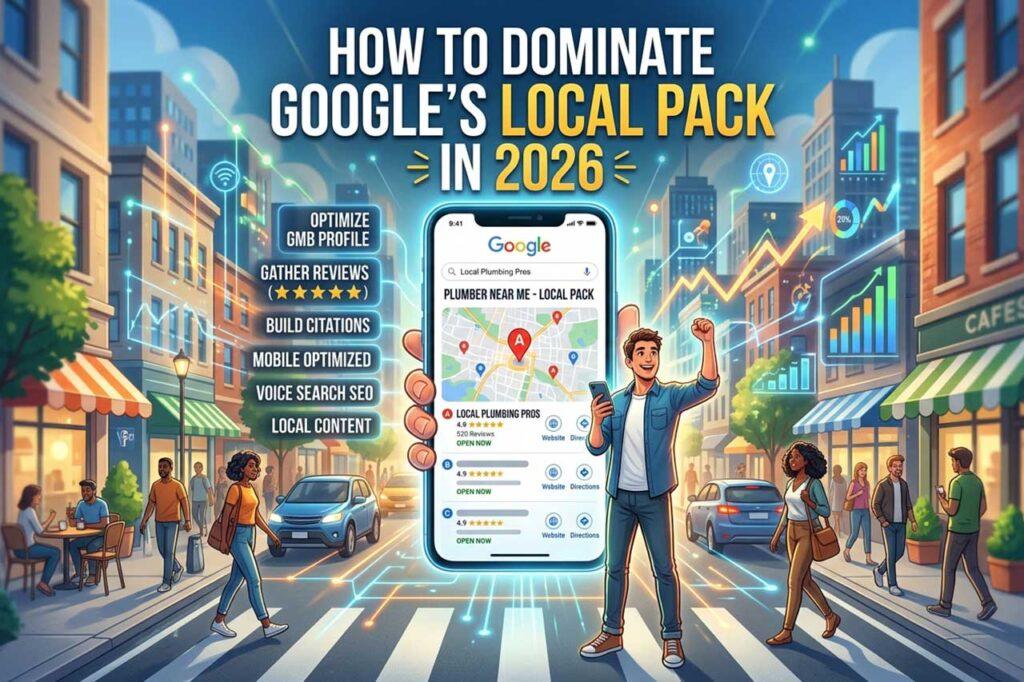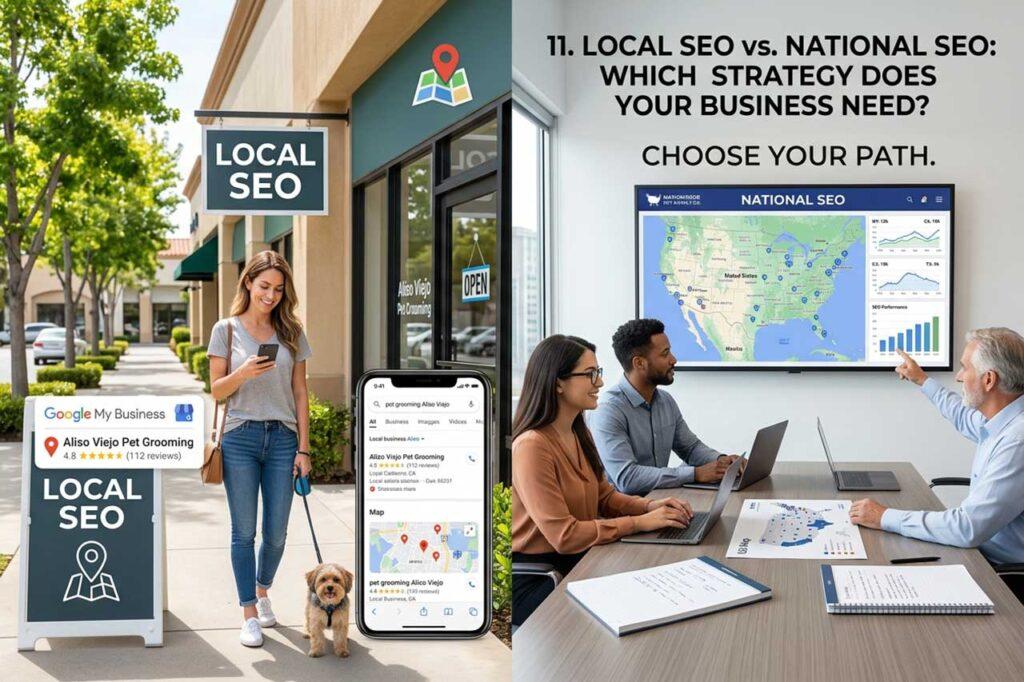

LA law firm digital marketing is the strategic use of SEO, paid advertising, and localized content to grow a law firm’s client base in the competitive Los Angeles legal market. With 58,000+ attorneys competing across dozens of distinct neighborhoods, generic online marketing fails. The firms winning new clients in 2026 deploy neighborhood-level SEO, AI-enhanced Google Ads, and compliance-first content built around what prospective clients actually search for. This guide walks you through every layer of an effective strategy, from budget planning and platform selection to content creation and performance tracking.
What tools does LA law firm digital marketing require?
Effective legal digital marketing in Los Angeles starts with the right stack of platforms, a realistic budget, and a clear compliance framework before you publish a single word.

Budget and timeline expectations
Monthly budgets of $1,000–$7,000 are standard for video marketing and SEO campaigns, with meaningful results appearing in 2–8 months. That timeline matters because many firms expect leads in week three and pull funding in month two, right before traction builds. Set internal expectations accordingly.
Core platforms and tools
- Google Ads with AI-powered Smart Bidding for paid search
- Google Business Profile for local map pack visibility
- Clio Grow and Lawmatics for CRM and lead intake automation
- Local SEO tools such as BrightLocal or Whitespark for citation management and neighborhood ranking tracking
- Grammarly and Hemingway Editor for content quality control before attorney review
Pro Tip: Connect your CRM directly to your Google Ads account. When Clio Grow or Lawmatics tracks which leads became paying clients, you feed that conversion data back into Google’s AI bidding system, which sharpens targeting over time.
Compliance prerequisites
All legal marketing content must comply with ABA Model Rules 7.1 and 7.2, which require truthful, non-deceptive communication reviewed by a licensed attorney before publication. Build an internal publishing checklist that includes a disclaimer review, a factual accuracy check, and attorney sign-off. Skipping this step exposes the firm to bar complaints and undermines the trust you are trying to build.
| Requirement | Platform or Process |
|---|---|
| Paid search campaigns | Google Ads with AI bidding |
| Local citation management | BrightLocal, Whitespark |
| Lead intake and CRM | Clio Grow, Lawmatics |
| Content compliance review | Attorney sign-off checklist |
| Content quality control | Grammarly, Hemingway Editor |
How can LA firms build neighborhood-level SEO authority?
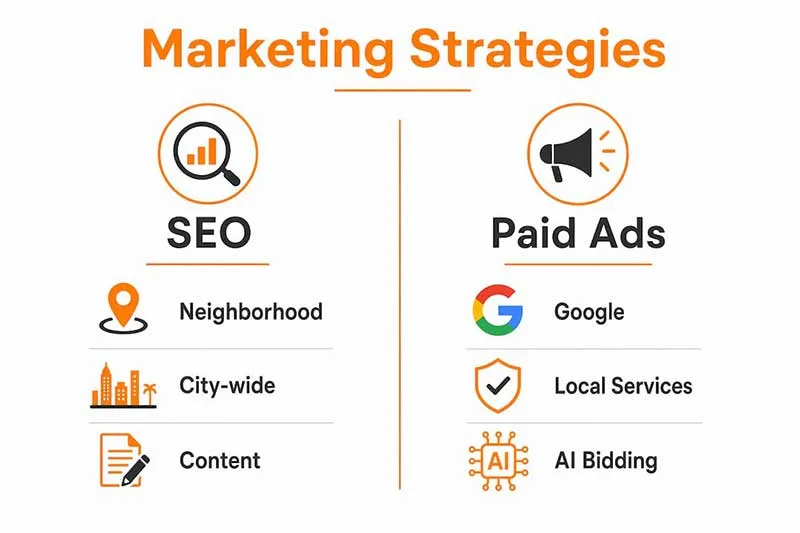
Los Angeles should be treated as dozens of individual neighborhoods, each with unique demographics, language preferences, and legal needs, rather than a single city market. Firms that ignore this reality compete for broad terms like “personal injury attorney Los Angeles” and lose to firms that own hyper-local search results in Beverly Hills, Koreatown, or Pasadena.
Steps to build a neighborhood SEO architecture
- Map your service geography. Identify the 10–15 neighborhoods where your ideal clients live or work. Cross-reference census data on income, language, and common legal issues.
- Create dedicated landing pages per neighborhood. Each page should reference local courts (such as the Stanley Mosk Courthouse or the Pasadena Courthouse), local demographics, and neighborhood-specific legal scenarios. This avoids thin content penalties while signaling genuine local relevance.
- Build practice-area pillar pages. A topical authority cluster with a central pillar page and 15–20 supporting sub-pages outperforms isolated blog posts for competitive legal keywords. One pillar page on “Car Accident Claims in Los Angeles” supported by sub-pages covering insurance disputes, uninsured motorist claims, and rideshare accidents builds E-E-A-T that Google rewards.
- Integrate bilingual content. Spanish-speaking residents make up a large share of LA’s population. Bilingual landing pages targeting Spanish-language search queries capture a segment most English-only firms ignore entirely.
- Audit for duplicate content. Scaling neighborhood pages creates duplication risk. Use canonical tags and ensure each page contains unique court references, local statistics, and community-specific language.
Neighborhood SEO vs. city-wide SEO
| Approach | Keyword Example | Competition Level | Conversion Rate |
|---|---|---|---|
| City-wide SEO | “divorce attorney Los Angeles” | Very high | Lower |
| Neighborhood SEO | “divorce attorney Pasadena” | Moderate | Higher |
| Bilingual neighborhood | “abogado de divorcio Koreatown” | Low | Highest |
Pro Tip: Reference the specific local courthouse on each neighborhood page. A page that mentions the Torrance Courthouse for South Bay clients signals local expertise to both Google and prospective clients.
What are the best paid advertising strategies for LA law firms?
Paid search is the fastest way to generate qualified leads in a competitive market, but only when the campaign is built correctly from the start.
Ai-enhanced google ads bidding
AI-integrated bidding improves cost-per-lead by 20–35% when fed high-quality conversion data. That improvement is not automatic. You must define what counts as a qualified conversion, whether that is a completed intake form, a phone call over 90 seconds, or a scheduled consultation. Feed those signals into Google’s system and the algorithm learns to find more of the same prospects.
Targeting and campaign structure
- Use high-intent keywords such as “hire a DUI attorney in Glendale” rather than broad terms like “lawyer near me”
- Segment campaigns by practice area and neighborhood, not by city
- Run Google Local Services Ads alongside standard search campaigns for the Google Guaranteed badge, which builds immediate trust
- Use Meta (Facebook and Instagram) ads for retargeting visitors who viewed your site but did not convert, since social platforms excel at awareness and re-engagement rather than direct intent capture
Before launching any PPC campaign, confirm your website converts visitors effectively. Sending paid traffic to a slow, unclear, or mobile-unfriendly site wastes every dollar you spend. A conversion-optimized site includes a prominent phone number, a short intake form, clear practice area descriptions, and fast load times on mobile.
Pro Tip: Run a 30-day test with Google Local Services Ads before scaling standard search campaigns. The Google Guaranteed badge often delivers lower cost-per-lead for high-trust practice areas like family law and estate planning.
For a broader view of digital marketing channels available to California businesses, the options extend well beyond paid search and are worth mapping against your firm’s goals.
How do you create compliant content that converts?
Content marketing for attorneys works when it answers the questions prospective clients are already asking, not when it lists the firm’s awards.
Shift from credentials to client pain points
Client-centric marketing that directly addresses potential clients’ pain points drives higher engagement than content focused on the firm’s accolades. A prospective client searching “what happens if I get a DUI in Los Angeles” wants a clear, empathetic answer. They do not want to read about your partner’s law school ranking.
Structure your content around three questions every prospective client has:
- What is my situation? Explain the legal issue in plain language.
- What are my options? Lay out realistic outcomes without overpromising.
- Why should I trust you? Show relevant case experience and client reviews.
Trust signals and compliance
Nearly half of clients prioritize experience with similar cases (48%) and firm reputation (44%), while 33% cite positive online reviews as a deciding factor. Reviews on Google Business Profile and Avvo directly influence whether a prospective client calls your firm or the next one on the list.
“Every piece of legal marketing content requires internal attorney review to ensure compliance with ethical advertising rules.” — Digital Marketing for Lawyers: 2026 Complete Guide
Video content with transcripts serves two purposes simultaneously. The video builds trust and engagement on your website and social channels, while the transcript feeds Google’s indexing and improves SEO. A 3-minute video answering “How long does a personal injury case take in California?” with a full transcript below it outperforms a 1,000-word blog post covering the same topic in most cases.
Lead magnets tailored to LA legal audiences, such as a downloadable guide on California tenant rights or a checklist for what to do after a car accident in Los Angeles, capture email addresses and start a relationship before the prospective client is ready to hire.
How do you measure and refine your legal marketing results?
Tracking the right metrics separates firms that grow from firms that spend without knowing why.
Key metrics to monitor
- Qualified leads per channel. Track which source (organic search, Google Ads, Meta ads, referrals) generates leads that actually become clients, not just form fills.
- Cost per qualified lead. Calculate this monthly by channel. A $200 cost-per-lead from Google Ads is excellent for a personal injury case worth $15,000 in fees.
- Conversion rate by landing page. If your Beverly Hills landing page converts at 2% and your Pasadena page converts at 6%, the Pasadena page tells you what works. Replicate its structure.
- Organic ranking movement. Track neighborhood-level keyword rankings monthly using BrightLocal or Google Search Console.
- Review velocity. Monitor how many new Google reviews you receive each month. A steady flow signals healthy client satisfaction and improves local pack rankings.
Pro Tip: Set up a monthly compliance review alongside your performance review. As your content library grows, older pages may drift out of compliance with updated ABA guidance. A quarterly audit prevents bar complaints from content you published 18 months ago.
Common mistakes that drain budgets
| Mistake | Consequence | Fix |
|---|---|---|
| Ignoring neighborhood SEO | Competing for unwinnable broad terms | Build location-specific landing pages |
| Launching PPC without conversion optimization | High spend, low leads | Audit site speed and intake forms first |
| Publishing without attorney review | Bar complaint risk | Implement mandatory sign-off checklist |
| Treating LA as one market | Wasted ad spend on wrong demographics | Segment by neighborhood and language |
Key takeaways
Effective Los Angeles legal marketing requires neighborhood-level SEO, AI-driven paid campaigns, and compliance-first content working together as a single system.
| Point | Details |
|---|---|
| Neighborhood SEO is non-negotiable | Build dedicated pages for each target neighborhood, referencing local courts and demographics. |
| AI bidding requires quality data | Feed qualified conversion signals into Google Ads to achieve 20-35% cost-per-lead improvement. |
| Content must be client-centric | Address client pain points and questions directly; credentials alone do not convert prospects. |
| Compliance is a prerequisite | Every piece of marketing content needs attorney review under ABA Model Rules 7.1 and 7.2. |
| Budget for a long runway | Expect 2-8 months before SEO and video campaigns deliver substantial, measurable results. |
What i have learned running digital marketing for LA law firms
Working with law firms across Los Angeles has taught me one thing most marketing guides skip: the biggest mistake is not a bad ad or a slow website. It is treating the LA market as uniform.
Firms that win in this city think like local operators. They know that a family law client in Torrance has different concerns, different language preferences, and different search behavior than a client in West Hollywood. When you build your SEO and content strategy around that reality, you stop competing on price and start competing on relevance.
I have also seen compliance treated as a legal department problem rather than a marketing advantage. Firms that publish attorney-reviewed, clearly disclaimed content build more trust than firms that publish fast and fix problems later. Prospective clients notice when a firm’s website feels careful and credible. That perception converts.
On the AI tools front: the technology is genuinely useful for automating keyword research, drafting content outlines, and analyzing campaign data. But it requires human oversight at every step, especially in legal marketing where a single inaccurate claim can trigger a bar complaint. Use AI to work faster, not to remove the attorney review step.
My advice to marketing managers: bring your legal partners into the strategy early. When attorneys understand why neighborhood-specific content and client-centric messaging outperform credential-heavy copy, they become your best advocates for the budget and the process.
— Sasan Raeisi
How los angeles SEO inc can help your firm grow
Los Angeles SEO Inc specializes in law firm SEO and digital marketing tailored to the LA market. The team builds neighborhood-level SEO architectures, manages AI-enhanced Google Ads campaigns, and produces attorney-reviewed content that converts prospective clients into consultations.
Every engagement starts with a market analysis covering your target neighborhoods, current keyword rankings, and website conversion performance. From there, Los Angeles SEO Inc builds a plan that fits your practice areas, budget, and compliance requirements. If you are ready to stop guessing and start growing, contact Los Angeles SEO Inc for a personalized strategy consultation.
FAQ
What is the average budget for LA law firm digital marketing?
Most law firms in Los Angeles spend $1,000–$7,000 per month on combined SEO and video marketing campaigns, with meaningful results appearing within 2–8 months of consistent investment.
How does neighborhood SEO differ from standard local SEO?
Neighborhood SEO targets specific communities like Beverly Hills or Pasadena with dedicated landing pages referencing local courts and demographics, rather than competing for broad city-wide keywords.
Do law firms need separate pages for each practice area?
Yes. Building a topical authority cluster with a central pillar page and 15–20 supporting sub-pages per practice area improves Google rankings more effectively than isolated blog posts.
What compliance rules apply to legal marketing content?
ABA Model Rules 7.1 and 7.2 require all legal marketing content to be truthful and non-deceptive, with a licensed attorney reviewing every claim before publication.
How much does AI bidding improve google ads performance for law firms?
AI-integrated bidding in Google Ads reduces cost-per-lead by 20–35% when the campaign is fed accurate, high-quality conversion data from qualified client intake signals.